What French Women Really Eat in a Day (No Calorie Counting Required)
A real day of eating in a French woman's life -- breakfast, lunch, gouter, dinner. No tracking, no restriction, just beautiful food and natural satisfaction.
 By Marion ·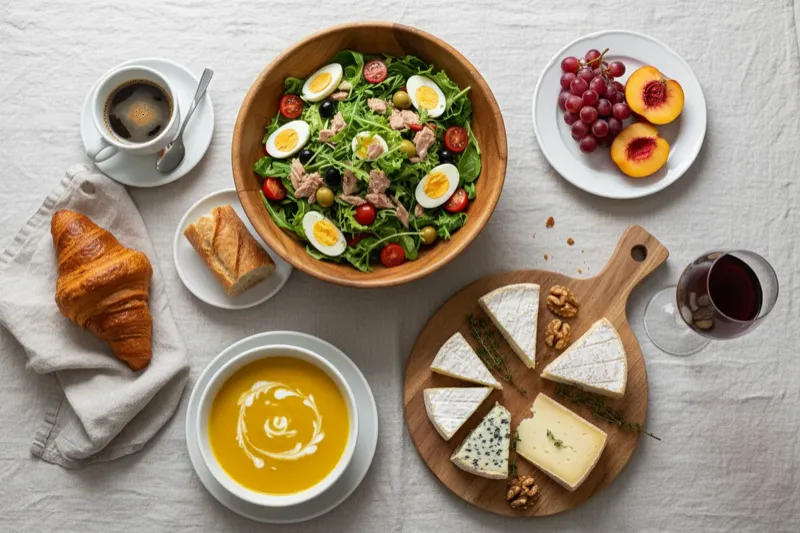
French women eat bread, butter, cheese, chocolate, and wine — every single day — without tracking a single thing. And France’s obesity rate is 17%, compared to 42% in the United States. If you have been told that weight management requires counting, measuring, and restricting, a real day of French eating will challenge everything you believe. Here is what it actually looks like, from morning to night, in the life of someone who has never downloaded a food tracking app. This is the French eating system in practice — not theory, not a meal plan, but life.
I am Marion, and people ask me this question more than almost any other: “What do you actually eat?” They expect something surprising. Some secret ingredient, some hidden restriction, some French superfood they have never heard of.
The truth is far more ordinary. And far more delicious. I eat normal food, at normal times, in normal amounts. That is the entire system. The magic is not in what I eat — it is in how I eat it and what I do not do.
Le Petit Dejeuner: French Breakfast (7:30 AM)
Let me walk you through my morning. I wake up, and I am hungry — not ravenous, just normally hungry. This is already different from many American women I know, who wake up either starving (because they under-ate at dinner) or nauseous (because they over-ate before bed).
My breakfast is simple.
A tartine: a slice of good bread — usually a sourdough or a pain de campagne — with a thin layer of salted butter and a drizzle of honey or a smear of apricot jam. A cafe au lait: strong coffee with warm whole milk. A small pot of plain yogurt, sometimes with a few walnuts dropped in.
That is it. The whole thing takes about fifteen minutes to prepare and eat. I sit at the table. I look out the window. I drink my coffee slowly. I am done.
No granola with twelve ingredients. No smoothie with protein powder and supplements. No egg white omelette with turkey bacon. No overnight oats measured to the gram in a mason jar.
Why this works: French breakfast is carbohydrate-forward on purpose, though no French woman would describe it that way. The bread provides glucose to wake up the brain. The butter provides fat for sustained energy. The yogurt provides protein and probiotics. The coffee provides the ritual. It is light enough that lunch still feels welcome when it arrives.
A 2020 study in the British Journal of Nutrition found that moderate, consistent breakfasts were associated with better appetite regulation throughout the day compared to either skipping breakfast or eating large, elaborate morning meals. The French breakfast hits this sweet spot instinctively.
What French Women Do NOT Eat for Breakfast
No protein shakes. No meal replacement bars. No “healthy” muffins. No bacon and eggs as a daily occurrence (this is a weekend luxury, and even then, it is modest). No cereal marketed with health claims.
The American breakfast has become either a performance (acai bowls, elaborate smoothies) or a shortcut (drive-through, protein bars). The French breakfast is neither. It is just breakfast. Small, real, and sufficient.
Le Dejeuner: French Lunch (12:30 PM)
Now we arrive at the heart of the French day. Lunch in France is still the main meal. This is perhaps the single biggest difference between French and American eating, and it changes everything.
On a typical weekday, my lunch looks like this:
Starter: A small green salad dressed with vinaigrette — olive oil, Dijon mustard, a splash of vinegar. Or a cup of soup, depending on the season. In winter, a bowl of leek and potato soup. In summer, a few slices of tomato with basil and olive oil.
Main course: Grilled chicken thigh with steamed haricots verts and a drizzle of olive oil. Or a piece of salmon with roasted vegetables. Or a lentil salad with goat cheese, walnuts, and a mustard vinaigrette. The protein changes, the vegetables change, but the structure is always the same: a protein, vegetables, and a source of good fat.
Bread on the table. I tear off a piece. I use it to push food onto my fork, to soak up the vinaigrette, to eat with cheese if there is some.
Dessert: A piece of fruit — a pear, an apple, a few clementines. Or two squares of dark chocolate. Or a small pot of creme caramel. Dessert is not a debate. It is the end of the meal. It signals to my brain: we are finished.
The whole lunch takes 30-45 minutes. If I am at home, I eat at the table. If I am at work, I step away from my desk. The French lunch break exists for a reason.
This is what staying slim without dieting looks like in practice: not a calculation, but a meal. Not a compromise, but a pleasure.
Why the Big Lunch Matters
Eating your largest meal in the middle of the day is not just cultural tradition — it is biological wisdom. Research published in Obesity (2013) by Dr. Marta Garaulet found that people who ate their main meal before 3 PM lost significantly more weight than those who ate it later, even when total intake was the same. The body processes food more efficiently during daylight hours when insulin sensitivity is higher.
By making lunch substantial, French women arrive at dinner without the ravenous hunger that drives overeating. They do not need willpower at 9 PM because their body has already received what it needed at 1 PM.
Le Gouter: The French Afternoon Pause (4:00 PM)
This is the part Americans find most confusing. Le gouter is technically a snack, but it does not function like American snacking.
Le gouter is primarily for children — a small tartine, a piece of fruit, a few squares of chocolate when they come home from school. For adults, it is optional and small: a coffee with a biscuit, a piece of fruit, a few almonds.
Here is the key difference: le gouter is a moment, not a grazing session. It happens at a specific time (around 4 PM), it involves sitting down, and it is over in ten minutes. It is not standing in the pantry eating handfuls of snacks while watching TV. It is not a “snack drawer” at your desk. It is not a protein bar eaten in the car.
On most days, I have a coffee and nothing else at this hour. Sometimes a piece of fruit. Maybe two squares of chocolate if I feel like it. There is no decision-making drama. There is no inner negotiation about whether I “deserve” it.
The French weight loss approach is not about eliminating snacking through discipline. It is about building meals substantial enough that the urge to snack simply does not arise.
Le Diner: French Dinner (7:30 PM)
Here is where another myth gets demolished. French dinner is lighter than lunch. This surprises Americans, who tend to make dinner the largest meal of the day — often the only real meal, after a day of under-eating and snacking.
A typical dinner at my home:
Option 1: Soup night. A bowl of homemade vegetable soup — leek and potato, butternut squash, or a classic soupe de legumes made from whatever vegetables are in the fridge. A piece of bread. A small piece of cheese. Done.
Option 2: Simple protein plate. An omelette with herbs and a green salad. Or a piece of quiche with salad. Or a plate of crudites (raw vegetables) with a slice of ham and some cheese.
Option 3: Leftover meal. Whatever is left from lunch, reheated and served with a fresh salad or a different side. French women are deeply practical about food. Nothing is wasted.
Dessert, if there is any, is a yogurt or a piece of fruit. Maybe a sliver of tarte from the weekend. Dinner is the bookend of the day — satisfying but not heavy.
The whole dinner takes about 30 minutes. We eat at the table. We talk about the day. The television is off. When we finish, we finish. There is no returning to the kitchen at 9 PM for a second round, because the day’s eating has been balanced and complete.
Why Light Dinners Support Natural Weight Balance
A 2017 study in the Journal of Nutrition found that front-loading food intake (larger breakfast and lunch, lighter dinner) was associated with lower BMI and better metabolic markers, independent of total intake. The body’s circadian rhythm makes it less efficient at processing food in the evening. French meal structure aligns perfectly with this biology — not because anyone planned it, but because centuries of cultural practice happened to get it right.
What Is NOT Part of a French Day
Sometimes what is absent matters more than what is present. Let me list what you will not find in my day.
No food tracking app. I do not know how many grams of anything I ate today. I do not care.
No food labels consulted. I buy ingredients, not products. Butter does not need a nutrition label. Neither does a chicken. Neither does a head of lettuce.
No internal negotiation. I did not debate whether I “should” have bread at lunch. I did not calculate whether the chocolate after dinner “fit” anything. I did not promise myself I would “be good tomorrow.”
No compensatory behavior. I did not eat less at dinner because I had chocolate at lunch. I did not walk farther because I had bread. Each meal is its own event. It does not need to be offset by anything.
No snacking between meals. Between breakfast and lunch, between lunch and dinner — nothing. Not because I am disciplining myself. Because I ate enough at my meals that I am genuinely not hungry.
This is what confuses Americans most. They see French women eating bread and butter and chocolate and wine, and they think: “She must be restricting somewhere else. She must be compensating. She must be secretly counting.” No. I am just eating. The absence of restriction is the system. And it is exactly what makes it work.
The Myth of the “French Diet”
I need to address something directly. There is no “French diet.” The phrase itself is an American invention, and it misunderstands everything.
A diet implies a temporary set of rules you impose on yourself to achieve a goal. It implies a “before” and “after.” It implies an end date.
What French women have is a way of living with food that does not start or stop. There is no “on the wagon” or “off the wagon” because there is no wagon. There is just a table, set with real food, shared with people you love, eaten slowly and with attention.
The difference between how the French eat and how Americans eat is not a list of different foods. It is a completely different relationship with the act of eating itself.
How to Start Eating Like a French Woman Today
You do not need to move to Paris. You do not need to overhaul your kitchen. Here are five things you can do starting with your next meal:
1. Make lunch bigger and dinner smaller. Even slightly. Have a real lunch with protein, vegetables, and bread. Then let dinner be simple — a bowl of soup, an omelette, a salad. Notice how much better you sleep.
2. Sit at the table without your phone. For one meal a day. Set a real plate. Use a real glass. Put the phone in another room. Notice how the food tastes different when you actually pay attention to it.
3. Include bread without apology. A piece of good bread with butter alongside your meal. Not the whole loaf. A piece. Notice that nothing bad happens. Notice that the meal feels more complete.
4. End with something sweet. Two squares of chocolate. A piece of fruit. A small cookie. Let your brain register: the meal is over. Notice how the desire to snack later diminishes.
5. Stop tracking. For one week. Delete the app, put the scale in the closet, and just eat real food at real meals. Notice the silence in your head where the numbers used to be. That silence is freedom.
This is how French women eat every day. Not perfectly. Not effortlessly. But with a deep, abiding pleasure that keeps them nourished, satisfied, and at peace with their bodies.
If you want the complete framework — the French meal structure, the shopping principles, the mindset shifts — I put it all into a free guide you can start using today.
Want the full French approach?
Get my free guide: "The 7 Habits That Naturally Trigger GLP-1"
Frequently Asked Questions
How to eat like a French woman?
Eat three structured meals a day of real, unprocessed food. Start with a light breakfast of bread, butter, and coffee. Make lunch your biggest meal with a protein, vegetables, and a small dessert. Have a light dinner with soup or a simple dish. Eat slowly, at a table, and never skip the pleasure.
What do French people eat in the morning?
A typical French breakfast is simple: a tartine (slice of bread with butter and jam or honey), a cafe au lait, and sometimes a piece of fruit or a yogurt. On weekends, there might be a croissant from the bakery. It is light, quick, and satisfying -- never an elaborate production.
What is the typical diet of a French person?
The typical French diet centers on three meals: a light breakfast of bread and coffee, a substantial lunch with vegetables, protein, and a proper dessert, and a lighter dinner of soup or a simple plate. Between meals, French people do not snack -- with the exception of le gouter, a small afternoon treat, mainly for children.
Do French women eat bread every day?
Yes, most French women eat bread every day -- at lunch and dinner, sometimes at breakfast. The difference is that French bread is made with just flour, water, salt, and yeast (no preservatives, no sugar), and portions are modest: a torn piece alongside the meal, not half a loaf.