What French Women Really Eat for Breakfast (It's Not What You Think)
French breakfast is smaller than you'd expect -- and that's the point. A light morning meal primes your appetite hormones for a satisfying lunch.
 By Marion ·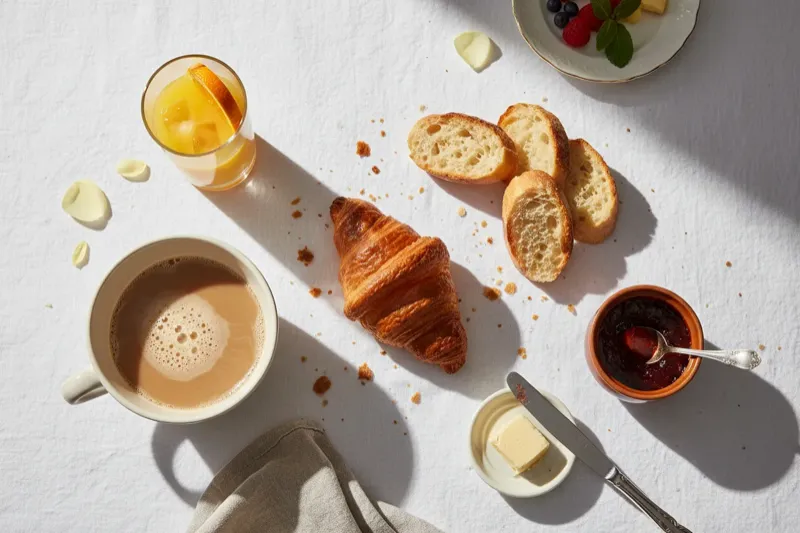
French women eat a breakfast that would horrify most American nutritionists — a slice of bread with butter and jam, a bowl of coffee, and nothing else — and yet this intentionally light morning meal is one of the reasons they maintain their weight effortlessly throughout their lives. The French breakfast is not small because French women are depriving themselves. It is small because it is designed to do one specific thing: gently wake the body and prime it for the real meal of the day, which is lunch.
I am Marion, and I need to confess something that will probably surprise you.
I do not eat eggs for breakfast. I have never had a protein shake in the morning. I have never “meal prepped” my breakfasts on Sunday afternoon. I have never once, in my entire life, eaten a smoothie bowl, an acai bowl, or an overnight oats situation before 8 AM.
What I eat every morning is almost embarrassingly simple. And I have eaten essentially the same breakfast since I was fourteen years old.
A tartine. Coffee. Sometimes yogurt. The end.
When I tell American friends this, they look at me with genuine concern. “But where is the protein?” they ask. “Don’t you crash by 10?” “Isn’t bread… bad?”
No. No. And absolutely not.
The Tartine: The Foundation of French Mornings
Let me describe a tartine for those who have not encountered one, because the word sounds fancier than the reality.
A tartine is a slice of bread — usually from a baguette, sometimes from a pain de campagne or a simple loaf — with butter spread on top. That is it. Some people add jam. Some add honey. Some eat it plain with just the butter. In my family, it was always salted butter and apricot jam, because that is what my mother bought, and nobody questioned it.
The bread is real bread. Not the soft, pre-sliced, shelf-stable product that Americans call bread. French breakfast bread has a crust that crunches. It has an interior that is chewy and slightly tangy from fermentation. It went stale yesterday, which is why you are toasting it this morning and buying a fresh one at the boulangerie on your way to work.
The butter is real butter. Full-fat. Often salted. Applied with a knife that leaves visible marks. Not a translucent scrape meant to provide the idea of butter without the commitment — a real, generous layer that melts into the warm bread and makes the whole thing taste like a very small, very satisfying miracle.
This is what French women have eaten for breakfast for generations. And nobody — not their doctors, not their mothers, not their skinny jeans — has ever suggested they stop.
Why “Breakfast Is the Most Important Meal” Is an American Invention
I want to address the elephant in the room, because I know it is there.
The idea that breakfast should be your biggest, most substantial meal of the day is not a universal truth. It is a marketing campaign. And understanding its origins will free you from a tremendous amount of unnecessary morning stress.
The phrase “breakfast is the most important meal of the day” was popularized in the early 1900s by Dr. John Harvey Kellogg — yes, the cereal magnate — who had a commercial interest in convincing Americans to eat a large grain-based morning meal. The campaign worked spectacularly. By the mid-20th century, the American breakfast had grown to include eggs, bacon, toast, juice, cereal, milk, and sometimes pancakes or waffles — a meal that in France would be considered an early lunch.
Subsequent research has consistently failed to prove that a large breakfast leads to better health outcomes. A comprehensive 2019 review in The BMJ examined 13 studies and concluded that eating breakfast did not reliably lead to weight loss, and that breakfast eaters actually consumed more total food over the course of the day.
French culture never absorbed this messaging. Breakfast in France remained what it had always been: a small, pleasant, bread-based affair that existed to accompany coffee and ease you into the morning. The French word for breakfast — petit déjeuner — literally translates to “little lunch.” The name itself tells you that this meal is not supposed to be big. It is supposed to be petit.
A Week of My Actual Breakfasts
I want to be concrete, because I think the specificity helps more than the theory. Here is what I actually ate for breakfast last week.
Monday: One tartine with salted butter and strawberry jam. Large café au lait. Half a banana that was getting too ripe.
Tuesday: One tartine with butter. Espresso. A small pot of plain yogurt with a drizzle of honey.
Wednesday: Two tartines (I was hungrier than usual — that happens). Café au lait. Nothing else.
Thursday: A croissant from the bakery near my office (I walked to get it). Espresso.
Friday: One tartine with butter and honey. Café au lait. A clementine.
Saturday: A pain au chocolat. A larger bowl of café au lait. Sitting on the balcony.
Sunday: One tartine. Coffee. A soft-boiled egg because it was Sunday and I felt like it.
That is it. No variety in the dramatic American sense. No rotation of “breakfast recipes.” No “shaking things up” with a new smoothie combination. The same essential breakfast, with tiny natural variations, repeated daily without boredom or complaint.
And here is what I want you to notice: I was not hungry at 10 AM on any of those days. Not once. Not even on Wednesday, when I ate more at breakfast than usual. I ate lunch around 12:30 each day, pleasantly and genuinely hungry — not desperate, not shaky, not thinking about food since mid-morning.
The light breakfast did its job. It always does.
The Science: Why Light Mornings Create Better Days
Let me explain why this works, because it is not magic. It is hormones.
When you wake up, your body is in a natural fasting state. Cortisol is peaking (the cortisol awakening response), which mobilizes stored energy and makes you alert. Insulin is low. Ghrelin (the hunger hormone) is moderate — present, but not screaming.
A light breakfast respects this hormonal state. The modest amount of carbohydrate from bread causes a gentle insulin rise — enough to provide fuel, not enough to cause a spike-and-crash cycle. The fat from butter slows glucose absorption, creating a smooth, steady energy curve. The coffee enhances alertness without disrupting the cortisol rhythm when consumed 60-90 minutes after waking.
A heavy breakfast fights this hormonal state. A large meal triggers a substantial insulin response, which can overshoot and cause a blood sugar dip by mid-morning. Your body diverts energy to digestion instead of cognition. The cortisol peak gets interrupted. And paradoxically, you end up hungrier sooner — because the crash creates an artificial energy deficit that your brain interprets as an emergency.
Research from the Journal of Clinical Endocrinology & Metabolism confirms this mechanism: larger breakfasts produce larger postprandial insulin responses, which correlate with earlier return of hunger. You eat more in the morning, and you still eat the same amount at lunch. The big breakfast does not save you anything — it just adds.
I discuss how this morning pattern connects to the full French day of eating in my article on what French women eat in a day. The light breakfast makes sense only when you see it in context.
The Coffee Ritual Is Part of the Breakfast
In America, coffee is fuel. You drink it to wake up, to function, to survive. Many women I know drink coffee instead of breakfast — a 16-ounce latte with sugar that serves as both caffeine delivery and caloric sustenance.
In France, coffee is the ritual around which breakfast happens.
The café au lait — a large bowl of strong coffee with hot milk — is as much a part of French breakfast as the food itself. Note: a bowl. Not a mug, not a to-go cup. French women drink their morning coffee from a wide, shallow bowl that you wrap both hands around, that forces you to sit down because you cannot walk and drink from a bowl, that slows you down simply by its shape.
This is not an accident. The form creates the function.
When you hold a warm bowl in two hands, you instinctively settle. Your shoulders drop. Your breathing slows. You sip rather than gulp. The warmth on your palms triggers a mild parasympathetic response — the opposite of fight-or-flight. You are, without trying, reducing your morning cortisol.
I wrote about this morning ritual in more depth in my article on the French morning routine that resets your appetite. The coffee ritual is not a nice addition to breakfast. It is breakfast.
Weekday vs. Weekend: The Gentle Difference
French breakfast does change on weekends, but not in the way American brunch culture suggests.
On weekdays, breakfast is a tartine. Fast, simple, eaten before work. Nobody lingers. Nobody makes it special. It is a daily habit performed with minimal thought, like brushing teeth.
On weekends, the upgrade is a croissant or pain au chocolat. That is the entire difference. The meal might last twenty minutes instead of ten. There might be fresh orange juice. The coffee bowl might be refilled. Someone might go to the market for a special bread.
But there is no French equivalent of American brunch — no eggs Benedict, no French toast (which, ironically, is not French), no bottomless mimosas, no two-hour restaurant meal at 11 AM. Weekend breakfast in France is a slightly fancier version of weekday breakfast, not a different category of experience.
This consistency is part of why it works. Your body thrives on routine. Your hunger hormones anticipate regular meals and prepare for them. When breakfast is the same basic meal every day — light, consistent, at roughly the same time — your appetite system calibrates itself around it. Lunch arrives on schedule. Dinner follows. The body knows what to expect and regulates itself accordingly.
The Protein Question: What Americans Get Wrong
I know the question is burning. So let me address it directly.
“Where is the protein?”
The honest answer is: not at breakfast. And that is fine.
The American obsession with breakfast protein comes from a legitimate place — protein increases satiety hormones and reduces ghrelin, which theoretically means you eat less later. But this research was done in the context of American eating patterns, where meals are irregular, snacking is constant, and the body never knows when food is coming next.
In a French eating pattern — where lunch is substantial, dinner is consistent, and snacking barely exists — you do not need protein at breakfast to manage hunger. You need it at lunch, where it appears in abundance: a piece of fish, a slice of quiche, a chicken breast, lentils, eggs, cheese. The daily protein intake is comparable; it is simply distributed differently.
French women get their protein at lunch and dinner. Breakfast is for carbohydrates and fat — quick energy and satiation. This division of labor has worked for centuries without causing protein deficiencies, muscle wasting, or uncontrolled hunger.
The insistence on “30 grams of protein at every meal” is an American framework projected onto a universal biological need. Your body does not care when it gets protein, as long as it gets enough over the course of the day.
Regional Variations: Breakfast Across France
Breakfast in France is remarkably consistent nationwide, but there are lovely regional touches.
In Paris, breakfast is often grabbed from a boulangerie on the way to the Métro — a croissant in a paper bag, eaten while walking. Parisians are the most likely French people to skip breakfast entirely, replacing it with an espresso at a café counter. Nobody judges this.
In Lyon, where I grew up, breakfast is more traditional. The tartine reigns. My neighborhood boulangerie opened at 6:30 and there was always a queue by 7 — women and men picking up a fresh baguette for the morning, still warm, tucked under the arm for the walk home.
In Provence and the South, Mediterranean influences creep in. Breakfast might include bread with olive oil instead of butter, or a drizzle of local honey, or fresh figs from the garden in summer. The spirit is the same — simple, light, bread-based — but the flavors reflect the southern terroir.
In Normandy and Brittany, butter rules absolutely. Salted butter from local cows, spread thick on dense country bread. A glass of fresh cider might replace coffee on a farm. Crêpes sometimes appear at breakfast, though they are more commonly an afternoon snack.
In Alsace, the Germanic influence shows: breakfast might include a slice of dense Kugelhopf (a yeasted cake), and the coffee might be stronger, served in smaller cups. Some families add a slice of cheese or a thin round of sausage — the one region where breakfast approaches something savory.
But across all regions, the principle holds: breakfast is small, bread-based, and not the point of the day.
How to Adopt the French Breakfast Without Moving to France
You do not need a boulangerie on your corner. You do not need to import French butter (though if you can find it, you should). You need three things:
1. Find Good Bread
This is the single most important change. Good bread — real bread, made from flour, water, salt, and yeast, with a crust and a texture — transforms breakfast from obligation to pleasure.
Look for sourdough, artisan loaves, or bakery bread at your local farmer’s market. Many grocery stores now carry decent baguettes or rustic loaves. If you cannot find good fresh bread, a quality whole-grain toast works perfectly well.
What to avoid: soft, pre-sliced sandwich bread that compresses into nothing when you press it. This bread does not toast well, does not hold butter well, and does not satisfy. It is engineered for convenience, not for pleasure.
2. Use Real Butter
Stop with the margarine. Stop with the light butter. Stop with the cooking sprays.
Good salted butter on warm bread is one of the simplest and most profound pleasures in the culinary world. It does not need justification. It does not need a health claim. It is butter on bread, and it is magnificent, and French women have known this forever.
A tablespoon of butter on your morning toast is not going to harm you. The fear of butter is a relic of 1990s nutrition science that has been thoroughly debunked. Butter provides fat-soluble vitamins, supports hormone production, and — most importantly — makes breakfast satisfying enough that you do not need to eat again until lunch.
3. Sit Down and Eat It
Not in the car. Not standing at the counter. Not walking to the train. Sit down, put it on a plate, pour your coffee into a real cup, and give yourself ten minutes.
Ten minutes. That is all. The magic of French breakfast is not the food — it is the sitting. The pause. The brief moment of stillness before the day’s machinery starts turning. This is where the cortisol regulation happens, where the satiety signals register, where your body learns that food is coming on a reliable schedule and stops hoarding.
You will be tempted to check your phone. You will be tempted to “use the time productively.” Resist. Unproductive minutes at the breakfast table are the most productive thing you can do for your appetite, your stress levels, and your relationship with food.
What My Mother Would Say
My mother, if she read this article, would be baffled by its existence. She would not understand why something so obvious requires 2,000 words of explanation.
“You eat breakfast,” she would say. “A tartine and coffee. Then you go to work. What is there to discuss?”
And she would be right. There is nothing to discuss. That is the whole point.
French breakfast works because nobody overthinks it. Nobody optimizes it. Nobody feels guilty about the butter or anxious about the bread or stressed about the lack of protein. It is a small, pleasant, daily non-event that quietly keeps everything else in balance.
The most revolutionary thing you can do for your morning is to stop making it revolutionary. Stop treating breakfast as a nutritional challenge to be solved. Stop researching the “best” morning foods. Stop wondering if you are doing it wrong.
Have some bread. Have some butter. Have some coffee. Sit down. Then get on with your day.
Your body already knows what to do with the rest. You can learn how French women approach the full day of eating — not just breakfast, but lunch, dinner, and everything in between — in my guide to French eating habits. It is simpler than you think. And it works better than anything you have tried.
As I explore in my article on how French women stay slim without dieting, the secret is never about one meal. It is about a rhythm — a daily pattern of eating that respects your body, your appetite, and your pleasure. Breakfast is just the first note. But when the first note is right, the rest of the melody follows.
If you are tired of overcomplicating your mornings and ready to eat with the simplicity and pleasure that French women have always known, I created a free guide that covers the full French approach. From breakfast to dinner, from weekdays to weekends — the principles that keep French women healthy, slim, and at peace with food. No rules. No restriction. Just a better way. Get your free guide here.
Want the full French approach?
Get my free guide: "The 7 Habits That Naturally Trigger GLP-1"
Frequently Asked Questions
What is a typical breakfast in France?
A typical French breakfast is simple and light: café au lait or espresso, a tartine (baguette slice with butter and jam), and sometimes yogurt or fresh fruit. On weekends, a croissant or pain au chocolat might appear. There is no bacon, no eggs, no protein-heavy spread. The French treat breakfast as a gentle awakening, not a performance meal.
What do people eat for breakfast in French?
The most common French breakfast is bread-based: a fresh baguette or toast with butter and jam, accompanied by coffee. Children might have hot chocolate and cereal. Some women add a pot of plain yogurt or a piece of fruit. The entire meal takes 10-15 minutes and is eaten at the kitchen table, not in the car.
What is a typical breakfast in Nice, France?
In Nice and the south of France, breakfast might include bread with olive tapenade or a thin socca (chickpea flatbread) from a market vendor, alongside the standard coffee. Southern French breakfasts are similar to the rest of France but sometimes incorporate Mediterranean flavors — olive oil, fresh figs, or local honey.