What Japan and France Know About Weight That America Doesn't
Japan and France have the lowest obesity rates in the developed world. Neither uses Ozempic or diet culture. Their shared secret is a cultural relationship with food.
 By Marion ·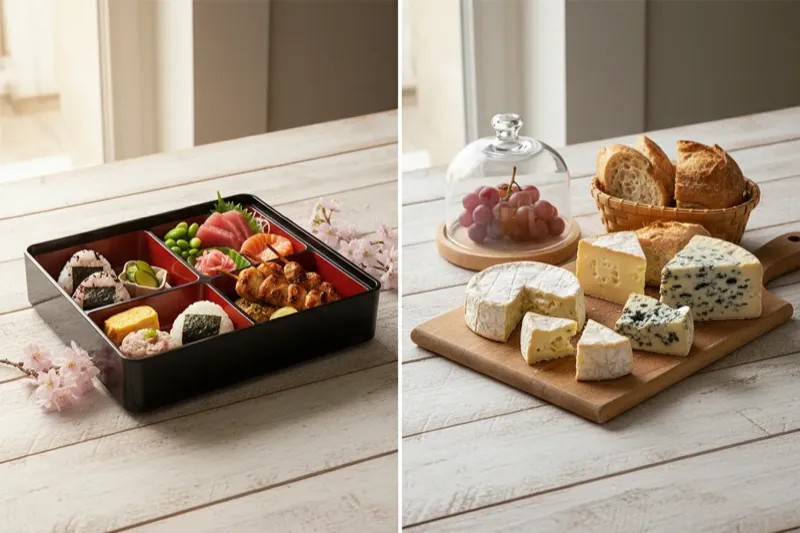
Medical Disclaimer
This content is for educational purposes only and is not medical advice. Ozempic (semaglutide) is a prescription medication. Consult your healthcare provider before making any changes to your medication or diet.
Japan’s obesity rate is 4.5%. France’s is 17%. America’s is 42%. Those three numbers tell you everything you need to know about weight — and none of it involves a prescription. The two leanest developed nations on earth have never used Ozempic, never embraced diet culture, and never declared war on food. What they have, instead, is a cultural relationship with eating that makes weight management invisible. Not effortful. Not heroic. Invisible. And when you look at what Japan and France share — despite being 6,000 miles and a world apart — the pattern is unmistakable. The French alternative to Ozempic is not just French. It is human. It is what happens when a culture treats food as a sacred daily practice instead of a problem to be solved.
I am Marion, and I have been fascinated by Japan for years. Not because I think French culture is insufficient — I am proudly French, down to my last croissant — but because Japan is the only country in the world where food culture functions at an even deeper level than ours. When I studied the Japanese approach to eating, I did not find something foreign. I found a mirror. Different flavors, different traditions, different aesthetics — but the exact same underlying principles.
And those principles are precisely the ones that America has abandoned.
The Numbers That Should End Every Diet Debate
Before we go further, let me lay out the data. Because this is not a cultural opinion piece. This is mathematics.
| Country | Obesity Rate | Avg. Meal Duration | Daily Steps | Snacking | Ultra-Processed Food (% of Diet) |
|---|---|---|---|---|---|
| Japan | 4.5% | 30-40 min | 6,500-8,000 | Rare | 12% |
| France | 17% | 33 min | 8,100 | 1x/day (children only) | 14% |
| United States | 42% | 11 min | 4,800 | 3-4x/day | 58% |
Look at those columns. Japan and France are remarkably aligned across every metric. And both are dramatically different from the United States — not in one area, but in all of them.
Now ask yourself: if two cultures on opposite sides of the world, with completely different cuisines, arrive at the same eating patterns and the same weight outcomes, is the pattern coincidental or fundamental?
It is fundamental. And that changes everything about how you should think about your own body.
Principle 1: Meals Have Structure
In Japan, a traditional meal follows a pattern called ichiju sansai — one soup, three sides. A bowl of miso soup, a portion of rice, a main protein (grilled fish, for example), and two or three small vegetable dishes. Everything is served at once, but in separate vessels, creating visual variety and natural portion awareness.
In France, a meal follows a progression of courses: a starter (often vegetables), a main course, cheese, and dessert. The meal moves through phases, each one building on the last, creating a rhythm that extends eating time and allows satiety hormones to activate.
Both structures accomplish the same thing: they make eating a deliberate, multi-step experience rather than a single, rapid act. Both prevent the “pile it on one plate and eat it in ten minutes” approach that dominates American eating.
The American meal, by contrast, has no structure at all. Everything arrives at once — or in sequence from a drive-through window. There is no progression, no rhythm, no built-in pauses. You eat until the plate is empty or until you actively decide to stop, which requires willpower that should never have been necessary.
The French meal structure and the Japanese meal structure are different expressions of the same truth: when eating has a form, the body regulates itself.
Principle 2: Portions Are Small, But Satisfaction Is Not
In Japan, food is served in small individual dishes — a practice that naturally limits portions while maximizing variety. A typical Japanese meal might contain seven or eight different items, each in a small bowl or plate. The total volume is moderate, but the experience is rich.
In France, portions are also smaller than American portions by 25-50%, according to research from Cornell University. But French food is rich — butter, cream, olive oil, cheese — so each bite delivers maximum flavor and satisfaction.
Both cultures have arrived at the same conclusion: you do not need to eat a lot. You need to eat well. A small bowl of perfectly seasoned miso soup. A thin slice of aged Comte with a ripe pear. These are not deprivation. They are precision. They deliver exactly what the body needs, in exactly the amount the body wants, with exactly the pleasure the brain requires to register “enough.”
The American approach — enormous portions of bland or over-sweetened food — creates the opposite dynamic. Because the food does not deeply satisfy, you need more of it to feel anything at all. It is the difference between sipping a glass of excellent wine and drinking a gallon of sugared water. One satisfies. The other just fills.
Principle 3: Walking Is Transportation, Not Exercise
The Japanese walk an average of 6,500 to 8,000 steps per day. The French walk approximately 8,100 steps. Americans walk about 4,800.
But here is the critical difference: in Japan and France, walking is not exercise. It is how you get places.
A Japanese businessman walks to the train station, stands on the platform, walks through the station at the other end, walks to his office. A French woman walks to the boulangerie, to the marche, to the pharmacy, to the cafe. Neither of them is “working out.” Neither is tracking steps on an app. They are simply living in environments designed for human movement.
America is designed for cars. You drive to work, drive to the grocery store, drive to the gym where you walk on a treadmill for 30 minutes, then drive home. The irony is painful. You are driving to a building where you pay money to simulate the walking that the rest of the world does for free.
Walking is the most metabolically friendly form of movement. It lowers cortisol (unlike intense exercise, which raises it). It improves insulin sensitivity. It supports healthy digestion. And it asks almost nothing of you except that you put one foot in front of the other.
French women stay slim without dieting partly because daily walking is woven into the fabric of their lives. Japanese people stay slim for the same reason. Neither culture treats movement as punishment for eating.
Principle 4: Eating Until 80% Full
The Japanese have a formal name for this principle: hara hachi bu. It translates roughly to “eat until you are 80% full.” This practice, particularly associated with the Okinawan population — one of the longest-lived groups in human history — means stopping before you feel stuffed. Stopping at comfortable. Stopping at satisfied.
The French do not have a formal name for this practice, but they have the exact same habit. Ask a French woman how she feels after a meal and she will say “comfortable.” Ask an American woman and she will say “full” — or “too full” — or “I shouldn’t have eaten that much.”
The 80% principle only works if you eat slowly enough to perceive it. And both Japanese and French meals are slow — 30 to 40 minutes on average. When you eat at that pace, you can feel the gradual climb of satiety. You can sense when you are approaching comfortable. You can stop there, naturally, without a battle.
When you eat in 11 minutes — the American average — there is no sensation of 80%. There is empty, then suddenly, painfully, 120%. The speed eliminates your ability to calibrate. It is like trying to park a car going 60 miles an hour. You will overshoot every time.
Principle 5: No Food Is Forbidden
In Japan, there are no “bad” foods. Rice — the most feared carbohydrate in American diet culture — is the center of every meal. Noodles are a staple. Tempura is fried. Sweet bean desserts are common. None of these foods carry moral weight.
In France, butter, bread, cheese, wine, and chocolate are daily staples. Not exceptions. Not treats earned through deprivation. Just food. Normal, daily, unremarkable food.
Both cultures prove the same principle: when no food is forbidden, no food is binge-worthy. The obsession, the craving, the cycle of avoidance and collapse — these are symptoms of prohibition, not of the food itself.
A Japanese woman eats rice at every meal and does not think about it. A French woman eats bread at every meal and does not think about it. An American woman avoids bread for three weeks, then eats an entire baguette standing at the kitchen counter at 10 PM, then feels shame about it for days.
The bread is not the problem. The three weeks of avoidance is the problem. Diet culture creates the very behavior it claims to solve, and both Japan and France demonstrate this by counterexample.
Principle 6: Food Is a Source of Respect, Not Anxiety
This is perhaps the deepest shared principle, and the hardest to quantify.
In Japan, there is a phrase spoken before every meal: itadakimasu. It means, roughly, “I humbly receive.” It is an expression of gratitude for the food, the people who prepared it, and the ingredients themselves. Every meal begins with a moment of acknowledgment that eating is meaningful.
In France, the equivalent is less formal but equally real. A French meal begins with appreciation — of the food, the company, the wine, the moment. “C’est bon” is one of the most common phrases in the French language. It is good. Not “it is healthy.” Not “it is low-fat.” It is good.
In both cultures, food is approached with respect. Not fear. Not suspicion. Not calculation. Respect.
American food culture approaches food with anxiety. Is it healthy? Is it organic? Does it have too much sugar? Should I be eating this? Am I going to regret this later? The emotional backdrop of an American meal is often a low-grade stress that poisons the experience before the first bite.
That stress is not neutral. It elevates cortisol. It impairs digestion. It prevents the brain from registering satisfaction. And it drives you to eat more, later, in an attempt to find the satisfaction that stress robbed from the original meal.
The French approach to eating without anxiety is not a luxury. It is a metabolic necessity.
What America Got Wrong
Looking at Japan and France together, the American mistake becomes painfully clear. It is not a mistake about food. It is a mistake about philosophy.
America medicalized eating. It turned food into a pharmaceutical problem — something to be measured, controlled, and optimized. It created an industry around the idea that human beings cannot be trusted to feed themselves, that we need apps and trackers and programs and now, injectable medications to do what our bodies were designed to do naturally.
Japan and France never medicalized eating. They culturalized it. They embedded healthy eating habits into the social fabric — into school lunches, family dinners, walking patterns, market culture, and daily rituals — so deeply that no one needs to think about them. The habits are invisible. And invisible habits are the only habits that last.
Ozempic is the logical endpoint of the American approach. When you have spent decades telling people that their bodies cannot be trusted, that their appetites are the enemy, that eating is a problem requiring ever-more-sophisticated solutions, eventually you arrive at a weekly injection that suppresses appetite artificially. It is the ultimate expression of the belief that nature is broken and only technology can fix it.
Japan and France look at this and do not understand the question. Why would you suppress your appetite? Your appetite is a perfectly functioning system. It tells you when to eat, what to eat, and when to stop. All you have to do is listen to it.
How to Adopt These Principles
You do not need to move to Japan or France. You need to adopt six principles that both cultures share. Here they are, translated for your life:
1. Structure Your Meals
Eat three meals a day. Give them a beginning, a middle, and an end. Start with something light — vegetables, soup, salad. Have a main course. End with something small and sweet. This structure extends your eating time, activates your satiety hormones, and gives you natural stopping points.
2. Serve Variety, Not Volume
Instead of one enormous plate, try two or three smaller elements. A bowl of soup and a piece of bread. A salad and a piece of fish. Multiple small experiences feel more satisfying than one large one because they engage more of your senses and create more moments of pleasure.
3. Walk Every Day
Not to burn anything. Not to earn food. Just walk. Ten minutes after lunch. Fifteen minutes in the evening. Walk to run an errand instead of driving. Build movement into your day the way Japan and France build it into theirs — as transportation, not punishment.
4. Eat Until Comfortable
Not full. Not stuffed. Comfortable. This requires slowing down enough to feel it — at least 20 minutes. Pay attention to the moment when the food starts to become less interesting, when the flavors dim slightly, when you could stop and feel content. That is 80%. That is enough.
5. Eat Everything. Forbid Nothing.
Bread. Rice. Pasta. Chocolate. Butter. Wine. Cheese. Eat them. Eat them without performance, without apology, without planning to compensate for them later. When everything is permitted, nothing is urgent. When nothing is urgent, portions take care of themselves.
6. Approach Food With Respect
Before you eat, pause for one moment. Not to pray, unless you want to. Just to acknowledge: this is food, and I am about to eat it, and that is a good thing. That single moment of respect changes the entire experience. It slows you down. It engages your attention. It activates the neural pathways that register satisfaction.
The Real Alternative to Ozempic
The pharmaceutical industry wants you to believe that your appetite is a disorder. Japan and France offer a different diagnosis: your appetite is a perfectly designed system that has been disrupted by a culture that forgot how to eat.
The solution is not to suppress the system with medication. The solution is to restore the conditions under which it works. Structure. Slowness. Pleasure. Variety. Movement. Respect.
These are not vague aspirations. They are specific, actionable practices that have been tested — not for decades, but for centuries — by two of the healthiest, leanest, longest-lived populations on earth. They are the original GLP-1 protocol. They are older than Ozempic, cheaper than Ozempic, and unlike Ozempic, they work forever.
You do not need Japan’s cuisine or France’s geography. You need their philosophy. And philosophy travels.
If you are ready to try the approach that Japan and France have used for centuries, start with my free guide: The French Alternative to Ozempic: 7 Secrets to Natural Weight Loss. It gives you the exact French eating principles — the same ones mirrored in Japanese culture — that naturally regulate appetite and body weight. No injection, no prescription, no deprivation. Just a way of eating that works.
Want the full French approach?
Get my free guide: "The 7 Habits That Naturally Trigger GLP-1"
Frequently Asked Questions
What is Japan's answer to Ozempic?
Japan does not need an answer to Ozempic because Japan does not have the same obesity crisis. Japan's obesity rate is 4.5% compared to America's 42%. The Japanese approach — small portions, structured meals, emphasis on variety and presentation, walking culture, and social eating — mirrors the French approach in many ways. Both cultures prove that the solution to weight is lifestyle, not medication.
What is the Japanese trick to lose weight?
There is no trick — there is a culture. Japanese eating habits include hara hachi bu (eating until 80% full), small varied dishes rather than one large plate, walking as primary transportation, and a deep cultural respect for food quality and presentation. Combined with structured mealtimes, these habits naturally regulate appetite and body weight without any conscious dieting.