How French Women Stay Slim Without Dieting: The Complete Guide
Discover why French women have 3x lower obesity rates without dieting. The complete guide to French meal structure, portion philosophy, and pleasure-based eating.
 By Marion ·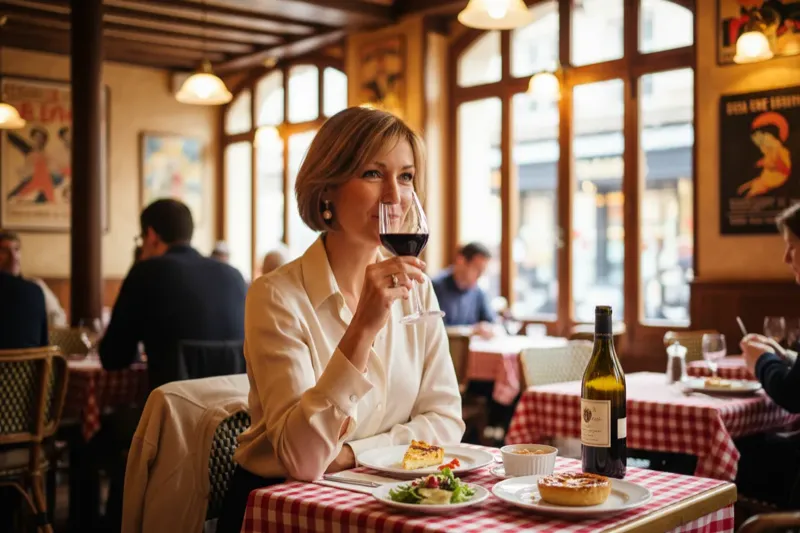
How do French women stay slim? The short answer is deceptively simple: they eat real food, at real meals, with real pleasure — and then they stop. No tracking, no food groups eliminated, no willpower battles. Just a fundamentally different relationship with eating that produces dramatically different results. France’s obesity rate sits at 17%. America’s is 42%. That is not a genetic accident — it is a cultural one. And the beautiful thing is that culture can be learned. I have put together a complete guide to French eating habits that walks you through every principle. This article is the deep dive.
My name is Marion, and I grew up in France eating bread every day, cheese at every dinner, and chocolate most afternoons. I have never been on a diet. Neither has my mother, my grandmother, or any woman in my family. This is not because we are blessed with some magical metabolism. It is because we eat in a way that makes dieting unnecessary.
When I moved to America, I was stunned by two things simultaneously: the obsession with dieting and the weight struggles that obsession produced. It seemed like a paradox — how could people who think about food constantly, who track every bite, who have an entire industry built around eating less… be gaining more?
But it is not a paradox at all. The obsession IS the problem.
The French Paradox Is Not Actually a Paradox
You have probably heard of the “French Paradox” — the observation that French people eat butter, cheese, bread, and wine yet have lower rates of heart disease and obesity than Americans. Researchers have been studying it since the 1980s. They have looked at red wine (resveratrol), they have looked at saturated fat, they have looked at genetics.
They have largely missed the point.
The “paradox” only exists if you believe that butter, cheese, and bread cause weight gain. They don’t — not in the way and amounts French people eat them. What causes weight gain is eating beyond your body’s needs, which is exactly what happens when you swing between restriction and overconsumption. And that is exactly what the American approach to food produces.
Here are the numbers that tell the real story:
- France obesity rate: 17% (OECD 2024)
- United States obesity rate: 42% (CDC 2024)
- Average daily walking: France 8,100 steps vs. US 4,800 steps
- Average meal duration: France 33 minutes vs. US 11 minutes
- Snacking frequency: France 1x/day vs. US 3-4x/day
These are not marginal differences. They are massive cultural gaps that compound over years and decades. Let me take you through each one.
The Meal Structure That Changes Everything
In France, we eat three meals a day. Breakfast, lunch, dinner. That is it.
This sounds almost absurdly simple, but it is the foundation of everything. Here is why it matters.
Breakfast: small and satisfying
A French breakfast is not a production. It is typically a tartine — a piece of good bread with butter and jam — with coffee or tea. Sometimes a croissant on weekends. Sometimes yogurt with a drizzle of honey.
What it is NOT: a smoothie bowl with twelve ingredients, a meal-prepped egg white scramble, a protein shake gulped in the car. The French breakfast is modest, pleasurable, and eaten sitting down. It takes ten minutes.
Why it works: The combination of carbohydrate, fat, and a small amount of protein gives your body a clear signal that the day has started. You are not overfull. You are not underfed. You are just… ready to go. And because you ate something genuinely enjoyable, your brain is not immediately planning what comes next.
Lunch: the real meal
In France, lunch is traditionally the biggest meal of the day. A proper lunch might be an entree (a small starter like a salad or soup), a main dish (protein with vegetables and a starch), and sometimes cheese or a small dessert. A glass of water. Perhaps wine if it is the weekend.
French lunch breaks are typically 45 minutes to an hour. In many French companies, eating at your desk is actually frowned upon (it was technically illegal until 2021). You leave. You sit. You eat slowly. You talk to someone if possible.
Compare this to the American lunch: a salad eaten at your desk in seven minutes, or a sandwich inhaled while driving, or — for women trying to “be good” — nothing at all, just coffee until dinner.
Why it works: When your biggest meal happens in the middle of the day, your body has hours to use that energy. You arrive at dinner genuinely hungry but not ravenous. And because you actually sat down and experienced lunch, your brain registered it. There is no late-afternoon desperation for snacks, no 4 PM trip to the vending machine, no standing in front of the fridge at 5 PM eating handfuls of crackers.
Dinner: lighter than you expect
French dinners are typically lighter than American ones. Soup with bread in winter. A vegetable gratin. A salad with cheese. An omelet with herbs. It is a real meal, but it does not leave you heavy.
Why it works: Your body does not need a massive input of energy at 8 PM. By eating lighter at night, you wake up with genuine appetite for breakfast. The cycle resets naturally, every day, without effort.
The missing piece: le gouter
There is one sanctioned “snack” in French culture, and it has a name: le gouter. It happens around 4 PM. It is typically something sweet — a piece of chocolate, a small pastry, a few biscuits with tea. Children have it. Adults have it. Nobody pretends it is a “protein snack” or justifies it with a workout.
Le gouter is not snacking. It is a ritual. It has a specific time, a specific place (sit down), and a specific portion (small). It exists to bridge the gap between lunch and dinner with pleasure. And then it is over.
This is profoundly different from American snacking, which has no boundaries — it happens all day, standing up, in the car, while watching TV, directly from the package. American snacking accounts for an estimated 25% of daily energy intake. French le gouter accounts for maybe 5%.
The Portion Philosophy: Small, Rich, Enough
One of the biggest differences I noticed when I moved to America was the size of everything. Restaurant plates the size of platters. Glasses of wine that hold half a bottle. Muffins the size of my head.
French portions are dramatically smaller. But here is the crucial thing: they are not smaller because French women are using willpower to eat less. They are smaller because the food is richer, more flavorful, and more satisfying — so you need less of it.
A French woman might have a sliver of dark chocolate after dinner. An American woman might eat a “light” chocolate bar that is three times the size but tastes like sweetened wax. The French woman is more satisfied with less food because she is eating food that is actually worth eating.
This philosophy extends to everything:
- Cheese: A small piece of excellent Comte, eaten slowly, vs. a handful of shredded low-fat cheese on a sad salad
- Bread: Two pieces of real baguette with dinner, eaten with butter, vs. avoiding bread entirely and then eating half a loaf at 10 PM
- Dessert: Three spoonfuls of creme brulee, savored, vs. a “guilt-free” pint of diet ice cream eaten straight from the container
The science backs this up. Research from Cornell University found that portion sizes in French restaurants are 25% smaller than American ones, and French packaged foods average 40% smaller. But satisfaction ratings are comparable or higher. French diners report greater enjoyment of their meals despite eating less food.
The trick is not eating less. The trick is eating better, which naturally leads to eating less without any conscious effort.
This concept is central to understanding the French weight loss trick — it was never about deprivation.
Walking: The Exercise That Doesn’t Feel Like Exercise
French women do not go to the gym. That is a generalization, of course — some do. But the cultural norm is not to have a gym membership. It is to walk.
French women walk to the boulangerie. Walk to the market. Walk to the Metro. Walk through the park. Walk after dinner. Walking is not exercise in France. It is transportation. It is pleasure. It is how you experience your city.
The average French person walks 8,100 steps per day. The average American walks 4,800. That difference — just 3,300 additional steps, roughly 25 minutes of walking — burns the equivalent of roughly 150 additional units of energy per day. Over a year, that is significant.
But the benefit of walking goes beyond energy expenditure. Walking reduces cortisol (the stress hormone that promotes belly fat storage). Walking improves insulin sensitivity. Walking stimulates gentle digestion after meals. And perhaps most importantly, walking gives you something to do with your body that is not punishing.
American exercise culture is built on punishment. Burn it off. Earn your food. No pain, no gain. This approach creates a toxic association between movement and suffering that makes most women eventually quit. And when they quit moving, they blame themselves.
French walking culture asks nothing of you except that you go outside and move your body at a pace that feels pleasant. That is sustainable. That is why French women do it their entire lives, from childhood through old age.
Pleasure-Based Eating: The Anti-Diet
Here is where we get to the heart of it. Everything I have described above — the meal structure, the portions, the walking — these are mechanisms. They work. But they work because of something deeper: the French relationship with pleasure.
In American diet culture, pleasure is the enemy. Pleasure is what makes you eat “too much.” Pleasure is what you are supposed to override with discipline. Food that tastes good is “tempting.” Food that tastes bad is “virtuous.”
In France, pleasure is the entire point.
Food should taste magnificent. Every meal should have something in it that makes you happy. The butter on your bread. The way the herbs smell in the pan. The first sip of wine. The crunch of a perfectly crusted baguette.
This is not hedonism. This is wisdom. Because when you eat with genuine pleasure and full attention, something remarkable happens: you need less food to feel satisfied.
Think about the last time you ate something truly extraordinary — maybe at a great restaurant, maybe something your grandmother made. You probably ate slowly. You probably savored every bite. And you probably stopped eating when satisfied, naturally, without anyone telling you to.
Now think about the last time you ate a “diet” food — something low-fat, low-sugar, low-joy. You probably ate it quickly. You probably still felt unsatisfied afterwards. You probably went looking for something else.
Pleasure is not the cause of overeating. The absence of pleasure is. When food does not satisfy you, you keep eating, searching for the satisfaction that never comes. When food truly satisfies you, you stop.
This is what I explore in depth when discussing why French women don’t diet — the mechanism is pleasure, not restriction.
The Science Behind the French Approach
This is not just cultural folklore. There is robust science behind why the French approach works.
Meal timing and circadian rhythm: A 2022 study in Cell Metabolism found that eating at consistent times each day synchronizes your circadian metabolic rhythm, improving insulin sensitivity and fat metabolism. The French eat at remarkably consistent times — lunch at noon, dinner at 7:30 or 8. This consistency alone has metabolic benefits.
Slow eating and satiety hormones: It takes approximately 20 minutes for satiety hormones (including GLP-1 and CCK) to reach the brain after eating. The average French meal lasts 33 minutes. The average American meal lasts 11 minutes. French people literally give their satiety hormones time to work.
The restriction-binge cycle: Research published in Psychological Science has repeatedly demonstrated that restriction of specific foods increases both craving for and consumption of those foods. By never restricting any food group, French culture avoids triggering this cycle entirely.
Walking and metabolic health: A meta-analysis published in JAMA Internal Medicine found that walking 8,000 steps per day was associated with a 51% lower risk of all-cause mortality compared to walking 4,000 steps. The French national average falls almost exactly at that threshold.
Portion satisfaction: A landmark study by Wansink et al. at Cornell found that French people stopped eating when they “no longer felt hungry,” while Americans stopped eating when “the plate was empty” or “the TV show was over.” This internal vs. external regulation is perhaps the single most important difference.
How This Applies to Women Over 40
I want to address something specific here, because many of the women who come to me are between 35 and 55, and they tell me a version of the same story: “This used to be easier. My body changed. Nothing works anymore.”
I hear you. And you are right that your body has changed. Hormonal shifts during perimenopause genuinely affect how your body processes and stores energy. I have written specifically about the French perimenopause approach because this phase deserves its own attention.
But here is what I want you to consider: French women go through perimenopause too. Their hormones shift. Their bodies change. And yet the obesity rate for French women over 50 is still dramatically lower than for American women in the same age group.
The difference? French women over 50 do not abandon their eating patterns and start restrictive dieting when their bodies change. They continue eating the same way they always have — structured meals, real food, pleasure, walking — and they allow their bodies to find a new equilibrium naturally.
The worst thing you can do during perimenopause is start restricting food. Your body is already under hormonal stress. Adding nutritional stress on top of it amplifies everything — the cravings, the sleep disruption, the weight fluctuation, the food noise.
The French approach during this time is not “less.” It is “better.” More nourishing foods. More rest. More walking. More pleasure. Less stress about the number on the scale.
5 Things You Can Start Today
You do not need to move to Paris. You do not need to learn French cooking. You just need to shift a few habits, one at a time.
1. Eat lunch like it matters. Tomorrow, take at least 20 minutes for lunch. Sit at a table. Put your phone away. Eat something that has actual flavor. Notice what happens to your afternoon energy and your evening appetite.
2. Add fat back to your food. If you have been eating fat-free yogurt, low-fat cheese, or dry toast, stop. Your body needs fat for satiety. Real butter. Good olive oil. Full-fat yogurt. You will eat less overall because you will actually be satisfied.
3. Walk for 20 minutes after dinner. Not a workout. A walk. Outside if possible. This is possibly the single most impactful habit you can adopt. It aids digestion, reduces evening snacking, improves sleep, and costs nothing.
4. Create a gouter ritual. Around 3:30 or 4 PM, have something small and pleasurable with a cup of tea. A piece of good chocolate. A few dried apricots and almonds. Make it intentional. This prevents the late-afternoon desperation that leads to pre-dinner overeating.
5. Serve smaller portions on smaller plates — but make them beautiful. The food should be excellent quality, arranged with care. You eat with your eyes first. A small, beautiful plate of food is more satisfying than a large, sloppy one.
What the French Approach Is NOT
Let me be clear about what I am not saying.
I am not saying French women are perfect. I am not saying France has no food problems (ultra-processed food is unfortunately increasing there too). I am not saying you should feel bad about being American. And I am absolutely not saying this is a diet.
This is a way of eating. It has no rules, no points, no phases. You will not be “on” it or “off” it. There is nothing to fail at. There is only a gradual shift toward eating that actually makes sense for your body and your life.
It is not fast. French women did not learn to eat this way in 21 days. They learned it over a lifetime, from their mothers and grandmothers, at thousands of family meals. You are starting later, and that is fine. The principles still work. They work because they are built on biology, not trends.
The Bigger Picture
When I look at the difference between how French and American women relate to food, I do not see a weight problem. I see a peace problem.
American women are at war with food. They are at war with their bodies. They are at war with their appetites. And wars are exhausting. They produce casualties. The casualty here is the simple, daily pleasure of eating — something that should bring joy, connection, and nourishment.
The French “secret” to staying slim is not a secret at all. It is the absence of war. It is the quiet, daily practice of eating well, with pleasure, and then moving on with your life.
You deserve that peace. You deserve meals that taste extraordinary. You deserve to eat bread without a mental debate. You deserve to walk through your neighborhood and feel the air on your face and call that enough exercise for today.
This is available to you. Not someday. Today.
Want the complete French eating framework? Download my free guide, The French Alternative to Ozempic: 7 Secrets to Natural Weight Loss. It is the starting point thousands of women have used to make peace with food — no medication, no restriction, no war with your body.
Want the full French approach?
Get my free guide: "The 7 Habits That Naturally Trigger GLP-1"
Frequently Asked Questions
How do French women stay slim?
French women stay slim through a combination of structured meals (three per day, no snacking), small satisfying portions of rich food, daily walking as transportation, and a pleasure-based approach to eating that prevents the binge-restrict cycle common in American diet culture.
Why are French people less obese?
France's obesity rate is 17% compared to America's 42%. The difference is cultural, not genetic: French people eat three structured meals, walk an average of 8,000 steps daily, eat slowly at tables without screens, and never demonize food groups like bread, cheese, or butter.
Why do the French stay thin while Americans gain weight?
The key difference is approach. Americans treat food as an equation to solve with rules and restriction, which triggers overeating. French people treat food as a pleasure to savor, which naturally regulates appetite through strong satiety signals and a peaceful relationship with eating.
Why do French people not gain weight?
French people do gain weight -- France is not immune to modern food trends. But their cultural habits provide natural protection: structured mealtimes, smaller portions served on smaller plates, high-quality ingredients that satisfy quickly, and a walking culture that builds daily movement into life.