What French School Lunches Look Like (vs American Cafeteria Food)
French school lunches have 4 courses, a cheese plate, and a sit-down dining experience. American kids get pizza and 20 minutes. The difference explains everything.
 By Marion ·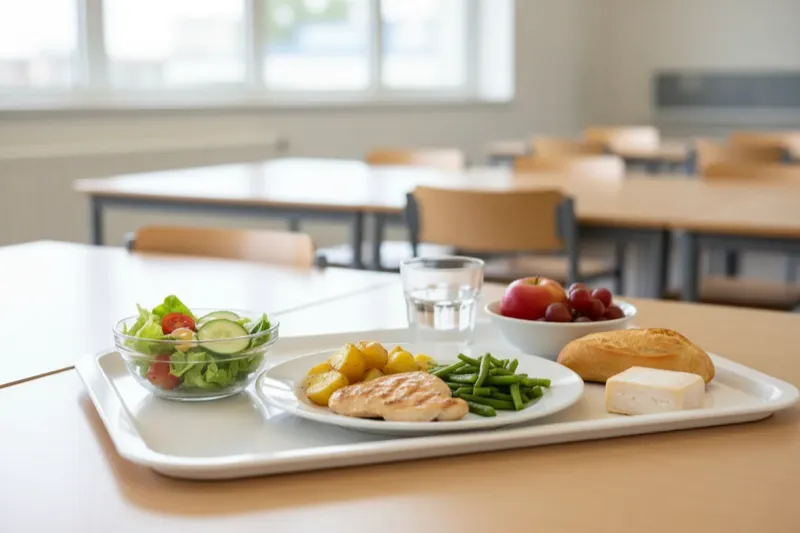
French children sit down to a four-course lunch at school every day — a vegetable starter, a main course with protein, a cheese plate, and dessert — served on real plates, with real utensils, for 30 to 45 minutes. American children get a tray of pizza, a carton of chocolate milk, and 20 minutes to eat it while sitting on a plastic bench. That contrast is not just interesting. It is the single clearest illustration of why France and America have radically different relationships with food, weight, and health. The habits that keep French women slim are not learned in adulthood. They are built in childhood, one school lunch at a time. Understanding French eating habits starts here — at the cantine.
I am Marion, and I went to public school in Lyon, France. Every day from the time I was six years old, I ate a four-course meal at a table with my classmates, served by kitchen staff who prepared everything from scratch that morning. I did not think this was special. I thought this was what school lunch was. When I moved to America and saw what children eat in school cafeterias here, I was — and I choose this word carefully — horrified.
Not because the food was different. Because the philosophy was different. In France, school lunch teaches children how to eat. In America, school lunch teaches children that eating does not matter.
A Real French School Lunch Menu
Let me show you what my niece ate at her public school in Lyon last week. This is a real menu, from a real French public school, serving ordinary children from ordinary families.
Monday
- Starter: Salade de betteraves — beet salad with vinaigrette
- Main course: Roti de porc, haricots verts — roast pork with green beans
- Cheese: Emmental
- Dessert: Pomme — a fresh apple
Tuesday
- Starter: Soupe de legumes — vegetable soup
- Main course: Filet de colin, riz pilaf — cod fillet with pilaf rice
- Cheese: Camembert
- Dessert: Compote de poires — pear compote
Wednesday
(No school in most French primary schools on Wednesday afternoons, but morning schools serve:)
- Starter: Carottes rapees — grated carrot salad with lemon
- Main course: Poulet roti, gratin dauphinois — roast chicken with potato gratin
- Cheese: Tome de Savoie
- Dessert: Yaourt nature — plain yogurt
Thursday
- Starter: Salade de concombre — cucumber salad
- Main course: Boeuf bourguignon, pates — beef stew with pasta
- Cheese: Comte
- Dessert: Clementine
Friday
- Starter: Taboulé — tabbouleh salad
- Main course: Saumon, epinards — salmon with spinach
- Cheese: Fromage blanc
- Dessert: Tarte aux pommes — apple tart
This is not a private school. This is not an elite institution. This is a standard French public school lunch, subsidized by the government, costing parents between 1 and 7 euros per meal depending on family income. The meals are designed by nutritionists, prepared by professional cooks, and served in a dedicated dining room — the cantine.
Every meal follows the same four-course structure: starter, main, cheese, dessert. Every meal includes a vegetable. Every meal is eaten sitting down, at a table, with real utensils and real plates.
What American School Lunches Look Like
Now let me describe what I have seen in American school cafeterias. I have visited schools across several states, and while there is variation, the pattern is remarkably consistent.
A typical American school lunch might be: a rectangle of pizza, a small bag of baby carrots (often untouched), chocolate milk, and a cookie. Or: chicken nuggets, tater tots, canned corn, and a juice box. Or: a pre-packaged ham and cheese sandwich, chips, an apple (often thrown away), and a carton of strawberry milk.
The food is served on a disposable tray or in packaging. Children walk through a line, collect their items, and carry them to long tables in a multipurpose room that doubles as a gymnasium or auditorium. The lunch period is 20 to 25 minutes — and that includes the time spent waiting in line, which can take 5 to 10 minutes.
The actual eating time is often 12 to 15 minutes.
There are no courses. There is no progression from light to substantial to sweet. There is no cheese course. There is no sitting down at a table set with care. There is efficient caloric delivery, and then there is recess.
I do not say this to shame American schools. I know the systemic challenges are enormous — funding, infrastructure, federal guidelines, and the sheer scale of feeding millions of children every day. But the contrast reveals something important about how each culture values the act of eating, and what children absorb from that value system.
What French Children Learn at the Cantine
The French school lunch is not just a meal. It is a class. An unspoken, daily lesson in how to be a person who eats well. Here is what French children learn at the cantine that American children do not:
They Learn to Eat in Courses
By the time a French child is seven, the four-course structure is second nature. Starter, main, cheese, dessert. This is not rigid — it is simply how meals work. And this structure has profound consequences for appetite.
The starter — always vegetables — begins the digestive process and starts the hormonal cascade of satiety. By the time the main course arrives, the child’s body has already begun registering food. By cheese and dessert, satiety hormones are at full strength. The child stops eating because her body tells her she is done.
An American child eating everything on a single tray in 12 minutes never receives these signals. The meal is over before the body has processed that it began.
They Learn to Try Everything
In French school canteens, there is a cultural expectation — sometimes a formal rule — that children must try every course. Not finish it. Try it. Put a bite in your mouth, taste it, and form an opinion.
This practice is revolutionary. By the time a French child reaches adulthood, she has tried hundreds of foods — beets, lentils, endive, sardines, rabbit, couscous, ratatouille, every cheese imaginable. Her palate is broad, her willingness to eat vegetables is high, and her relationship with food is curious rather than fearful.
American children, by contrast, are often served the same rotation of pizza, chicken nuggets, hamburgers, and macaroni and cheese — foods selected because they are universally “liked.” The result is a narrowing of the palate, a preference for processed flavors, and a deep suspicion of vegetables that can last a lifetime.
They Learn That Meals Take Time
A French school lunch period is 60 to 120 minutes. The meal itself takes 30 to 45 minutes. Children eat, talk, and sit at the table until the meal is complete. They are not rushed. They are not told to hurry up and go play. The meal is the activity.
This teaches children something essential: eating is worth your time. It is not an interruption to the real activities of the day. It is one of the real activities.
By adulthood, this becomes instinctive. A French woman would no more eat a meal in 8 minutes than she would read a book by flipping through the pages. The 20-minute dining rule that activates satiety hormones is not something French women have to learn. They absorbed it at age six.
They Learn That Food Is a Communal Experience
In French school canteens, children eat together. They sit at tables. They pass bread. They talk. The meal is a social event, not a solitary fueling station.
This creates a powerful association between food and connection that lasts a lifetime. French women eat with other people. They talk during meals. They share food. They celebrate at the table. Eating is woven into the social fabric of life, not separated from it.
When eating is social, it naturally slows down. When it slows down, the body’s satiety system works. When the satiety system works, portions regulate themselves. The communal table is the original appetite control mechanism. French women stay slim without dieting in large part because they never eat alone, hunched over a desk, shoveling food without tasting it.
Le Gouter: The Only Snack That Exists
In French culture, there is exactly one between-meal eating occasion, and it is exclusively for children. It is called le gouter — the afternoon snack — and it happens at approximately 4 PM, when children come home from school.
Le gouter is not a handful of goldfish crackers eaten absentmindedly in front of a screen. It is a small, specific, ritualized event. A piece of bread with a few squares of chocolate tucked inside. A tartine with butter and jam. A small biscuit and a glass of milk. A piece of fruit.
It is served at the table. It takes five minutes. And then it is over.
Adults do not eat le gouter. The idea of a grown woman snacking at 3 PM would be considered slightly strange in France. Not because it is forbidden, but because the concept simply does not exist in the adult food landscape. If you ate a proper lunch — a real, four-course, 30-minute lunch — you are not hungry at 3 PM. There is nothing to snack on because there is no need.
The American snacking culture — where adults eat 3 to 4 times between meals, where there are entire grocery aisles devoted to “snack foods,” where eating between meals is considered normal and even recommended — would genuinely confuse most French people. Why French women never count what they eat is partly because their food landscape is so much simpler. Three meals. One childhood snack. That is the entire map.
Why This Matters for You
You might be reading this and thinking: this is interesting, but what does it have to do with me? I am not a French schoolchild. I cannot go back and rebuild my childhood eating habits.
But here is what I believe: understanding where healthy eating habits come from gives you permission to adopt them now. The French do not have a genetic advantage. They do not have better willpower. They have a culture that teaches, from age six, that meals are structured, food is pleasurable, eating takes time, and the table is a place of connection.
You can build this culture in your own home. You can build it today.
Bring Back the Starter
Before your main plate, serve yourself a small vegetable course. A simple salad. A cup of soup. Sliced tomatoes with olive oil and salt. This one addition extends your meal by 5-7 minutes, starts your satiety hormones, and adds vegetables to your day without any effort or moral drama.
Sit at a Table
Not the couch. Not the car. Not standing at the counter. A table, with a plate, with utensils. This single change transforms eating from a mechanical act to a conscious one. Your brain registers the meal differently when it happens at a table. You eat less. You enjoy more.
Give Yourself 25 Minutes
You do not need the full French two-hour lunch. But you need more than 11 minutes. Set a minimum of 25 minutes for lunch and dinner. If you finish your food in 15, sit for 10 more. Drink water. Look out the window. Let your body catch up.
End the Meal With a Closing Course
A piece of fruit. A square of chocolate. A small piece of cheese. Something that signals: the meal is complete. The French dessert secret is not about indulgence — it is about closure. When a meal has a defined ending, your brain stops searching for more.
Eat With People When You Can
If you live with others, eat at the same time, at the same table. Talk. Share food. Make the meal a moment of connection rather than a task to complete. If you eat alone, make it intentional: set a place for yourself, put on music, treat the meal as an event rather than an interruption.
The Deeper Lesson
The comparison between French and American school lunches is not really about the food. It is about what each culture believes eating is for.
In America, school lunch is fuel. It is a logistical problem to be solved as efficiently as possible so that children can get back to the things that matter — learning, testing, performing.
In France, school lunch is one of the things that matter. It is education in taste, in patience, in sociality, in pleasure. It is the daily practice of a skill that will serve these children for the rest of their lives: the ability to sit down, eat well, enjoy it, and stop when they are satisfied.
That skill is the foundation of the French approach to food — the reason French women stay slim without programs, without tracking, without the exhausting cycle of deprivation and regain that defines American diet culture.
You were not raised in a French cantine. But the principles are simple, they are transferable, and they work at any age. Structure your meals. Eat at a table. Take your time. Include vegetables, protein, and pleasure. End with something sweet. And treat the meal itself as one of the most important things you do each day.
Because it is.
If the French approach to food resonates with you, download my free guide: The French Alternative to Ozempic: 7 Secrets to Natural Weight Loss. It covers the complete system — from meal structure to GLP-1-boosting foods to the pleasure principle that makes French women naturally slim. No medication, no deprivation, just a better way to eat.
Want the full French approach?
Get my free guide: "The 7 Habits That Naturally Trigger GLP-1"
Frequently Asked Questions
What is a typical school lunch in France?
A typical French school lunch has four courses: a vegetable starter (grated carrots, beet salad, or soup), a main course with protein and a side (roast chicken with green beans, fish with rice), a cheese course, and dessert (usually fresh fruit, sometimes a small pastry). Children sit at tables with tablecloths, eat with real utensils, and lunch lasts 60-90 minutes.
What is a typical French after school snack?
The French after-school snack is called le goûter, and it is the only acceptable between-meal eating in French culture. It typically consists of bread with chocolate, a piece of fruit, or a small biscuit with milk or juice. It is served at a consistent time (around 4 PM) and is considered a small, ritualized meal for children — not mindless grazing.
How long is lunch break in French schools?
French school lunch breaks last between 60 and 120 minutes, depending on the school. This is not just for eating — it includes playtime — but the meal itself takes 30-45 minutes. Children eat in a dedicated dining room (the cantine) and are expected to try every course. This stands in stark contrast to the 20-25 minute lunch breaks common in American schools.