French Portion Sizes vs American: The Visual Guide That Will Change How You Eat
French portions are 25% smaller than American ones -- but the meals are richer, slower, and more satisfying. This visual comparison will change how you think about food.
 By Marion ·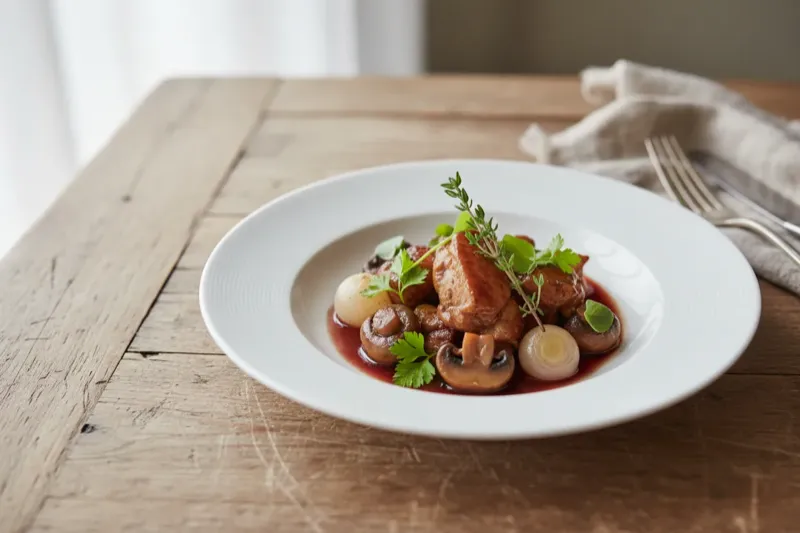
French portions are 25% smaller than American portions on average, and in some categories the gap is 50-100% — yet French people report higher meal satisfaction, lower rates of between-meal hunger, and an obesity rate less than half of America’s. This is not a paradox. It is a lesson in the difference between volume and satisfaction. More food does not mean more pleasure. In fact, as you are about to see, the opposite is often true. The French prove daily that smaller, richer, slower meals produce deeper satisfaction than the enormous, rushed plates Americans have been trained to expect.
I am Marion, and I have a vivid memory from my first year in America that still makes me laugh. I ordered a pasta dish at a restaurant in Chicago. When the plate arrived, I genuinely thought it was meant for two people. I looked around for the second plate. There was no second plate. That mountain of pasta — enough to feed a French family of three — was my personal dinner.
I ate perhaps a third of it. My American friend cleaned her plate. She had been doing this her entire life. She was not greedy. She was not undisciplined. She was responding normally to an abnormal amount of food. And this, I realized, is the invisible engine driving the weight gap between our two countries.
The Research: How Big Is the Gap?
The most comprehensive study of French vs. American portion sizes was conducted by Dr. Paul Rozin and his team at the University of Pennsylvania. Published in Psychological Science, the research compared portions across restaurants, supermarkets, cookbooks, and home meals in Philadelphia and Paris. The findings were stark.
Restaurant portions: American restaurant entrees were 25% larger than French restaurant entrees on average. In fast food, the gap widened — a medium order of fries at McDonald’s in Philadelphia contained 72% more food than a medium order at McDonald’s in Paris.
Supermarket products: American yogurt containers (170-227g) were 36-82% larger than French yogurt containers (125g). American soft drink bottles were nearly twice the size. American candy bars were 41% larger.
Cookbooks: Recipes in American cookbooks yielded portions 25% larger than equivalent recipes in French cookbooks.
Meal duration: Despite eating less food, French diners spent significantly more time eating — an average of 33 minutes per meal compared to 11 minutes for Americans. More time, less food. More satisfaction.
This last finding is the key to everything. The French are not depriving themselves. They are spending more time with less food and extracting more pleasure from it. They are not eating less — they are eating differently. And the result is a population that is, on average, significantly leaner.
The Visual Comparisons: A Side-by-Side Tour
Let me take you through a day’s worth of eating, French portions versus American portions, so you can see the gap with your own eyes.
Breakfast: The Coffee
In Paris: A cafe creme arrives in a ceramic cup holding approximately 150 milliliters — about five ounces. It contains a shot of espresso and steamed whole milk. No whipped cream. No syrup. No sprinkles. It is small, hot, strong, and complete. You drink it in five minutes at the counter of a cafe or at your kitchen table. Cost: 2-3 euros.
In America: A Starbucks Grande latte contains 473 milliliters — about 16 ounces, more than three times the French cup. A Venti is 591 milliliters. Many are flavored with syrups that add sweetness and liquid volume. The drink is carried in a car, sipped over an hour, and treated as both beverage and snack. Cost: $5-7.
The gap: The American coffee is 200-300% larger. It takes three times longer to consume, not because it is savored but because it is enormous. And it often replaces a real breakfast, leaving the drinker hungry by 10 AM and reaching for a snack.
Breakfast: The Food
In France: A tartine — a piece of baguette, split and toasted, with butter and jam. Or a croissant. Or a bowl of yogurt with fruit. The entire breakfast fits on a small plate. It is eaten at a table, in about 10 minutes.
In America: A breakfast platter at any chain restaurant includes two or three eggs, bacon or sausage, hash browns, toast with butter, and a side of pancakes or fruit. The plate is the size of a serving platter. Or it is a bagel — which has grown from 3 inches in diameter in the 1970s to 6 inches today, effectively doubling in size within a generation.
The gap: The American breakfast contains roughly 2-3 times the volume of a French breakfast. But here is the irony — many American women skip breakfast entirely or eat a “healthy” breakfast bar, then overeat later. The French eat a small, real breakfast every day and are satisfied until lunch.
Lunch: The Main Event
In France: Lunch is the biggest meal. A typical bistro lunch is a formule — a two-course menu. Perhaps a small salad with vinaigrette, followed by a piece of grilled fish with vegetables and a few boiled potatoes. Or a bowl of soup, followed by a croque-monsieur. A glass of water. Perhaps a small dessert — a creme caramel or a piece of fruit. The main plate is perhaps 20-22 centimeters in diameter. The protein is the size of a deck of cards. The vegetables and starch fill the rest without piling upward.
In America: A lunch entree at Applebee’s, Cheesecake Factory, or any mid-range restaurant arrives on a plate 28-30 centimeters in diameter, often overflowing. A Cheesecake Factory pasta dish weighs, on average, 500-700 grams — enough for two or three French servings. The chicken breast is the size of a novel. The portion of fries could fill a shoebox.
The gap: The American plate contains 50-100% more food. And because American meals are eaten faster — the average American lunch lasts 11 minutes vs. the French 33-45 minutes — satiety signals never have time to engage. You finish the plate not because you are still hungry, but because you eat faster than your hormones can signal “enough.”
The Steak Comparison
This one is particularly vivid.
In France: A bavette (flank steak) or entrecote (rib steak) at a Parisian bistro weighs 150-200 grams (5-7 ounces). It is served with a small mound of frites — perhaps 100 grams — and a green salad. The plate is not crowded. There is white space. The steak is the focus, and it is cooked beautifully, with a shallot sauce or a pat of herb butter.
In America: A steak at Texas Roadhouse, Outback, or a standard American steakhouse weighs 340-450 grams (12-16 ounces). The “small” option is often 8 ounces — still larger than the French standard. It arrives with a loaded baked potato, a side of broccoli drowning in cheese sauce, and a basket of bread. The plate is a landscape.
The gap: The American steak is 100-200% larger. But here is what matters: the French steak, at half the size, is not a sacrifice. It is savored over 40 minutes, with wine, with conversation, with the knowledge that cheese and dessert are still coming. The smaller steak is part of a larger meal experience that adds up to deeper satisfaction.
The Cheese
In France: After the main course, a small cheese plate appears. Two or three types, each a sliver — perhaps 30 grams total. A Comte, a chevre, a wedge of Roquefort. A piece of bread to accompany. This is not a snack. It is a course. It lasts five minutes and it signals that the meal is entering its final, luxurious act.
In America: Cheese is eaten in blocks. Sliced off the supermarket brick and placed on crackers — 60, 80, 100 grams at a time, often standing at the counter. Or it is sprinkled over everything — nachos, burgers, salads, baked potatoes — as a topping rather than a star. The quantity is often three to four times what a French woman would eat in a sitting, but the experience is diminished because the cheese is an afterthought rather than a moment.
The gap: Americans eat more cheese by weight but less cheese by experience. The French make a small amount of excellent cheese into a ritual. Americans make a large amount of average cheese into background noise.
The Dessert
In France: A typical weeknight dessert is a piece of fruit. A clementine, a pear, a few strawberries. On a restaurant night, it might be a mousse au chocolat served in a small ramekin (100 ml), a tarte aux pommes slice (a single, thin wedge), or a creme brulee in a dish the size of a teacup. The dessert is small, intense, and final.
In America: A slice of Cheesecake Factory cheesecake weighs approximately 300 grams and stands four inches tall. A standard restaurant brownie sundae involves a brownie the size of a paperback book, three scoops of ice cream, whipped cream, and chocolate sauce. The portion is meant to be impressive — to justify the $12 price tag through sheer volume.
The gap: The American dessert is often 300-400% larger than the French equivalent. But the French dessert secret is this: a small, perfect dessert after a multi-course meal creates complete satisfaction. You do not need a 300-gram slice of cheesecake if your meal has already delivered pleasure through variety, quality, and pace.
Why Bigger Portions Do Not Mean More Satisfaction
This is the central insight of the portion comparison, and it is backed by decades of research: satisfaction does not scale linearly with quantity.
Dr. Brian Wansink, in his landmark book Mindless Eating, demonstrated that people given larger portions eat 25-50% more without reporting any greater enjoyment or satisfaction. In one famous study, subjects given a “bottomless bowl” of soup (which was secretly refilled from below) ate 73% more soup than the control group — but rated their fullness identically.
You eat what is in front of you. And you enjoy it roughly the same regardless of how much there is. The first three bites of any food deliver the peak of flavor experience — subsequent bites provide diminishing sensory returns. A 200-gram steak delivers nearly the same pleasure as a 400-gram steak. The additional 200 grams is metabolically processed but sensorially redundant.
French portions are calibrated — culturally, not consciously — to this reality. They deliver the pleasure without the excess. They end while you still want them, which paradoxically creates more satisfaction than American portions that end when you feel stuffed.
There is a world of difference between “satisfied” and “stuffed.” The French live in the first. Americans, trapped by enormous plates and the social pressure to finish them, live in the second.
The Plate Size Effect
Here is something that sounds trivial but is actually one of the most robust findings in eating behavior research: plate size determines portion size.
A standard French dinner plate is 23-25 centimeters in diameter. A standard American dinner plate is 28-30 centimeters. This 5-centimeter difference translates to a 44% larger plate surface area — and studies show that people fill the plate to roughly the same proportion regardless of its size.
Dr. Wansink’s research found that switching from a 30cm plate to a 25cm plate reduced food intake by 22% — with no change in reported satisfaction. The subjects literally did not notice they were eating less. Their eyes told them the plate was full. Their stomachs confirmed they were satisfied. The only thing that changed was the number.
French homes use smaller plates. French restaurants use smaller plates. French servingware is, across the board, scaled down compared to American equivalents. Wine glasses, coffee cups, dessert bowls, bread baskets — everything is smaller, and everything is sufficient.
This is not deprivation. It is design. The French food environment is designed — through centuries of cultural evolution, not conscious planning — to deliver satisfaction at a scale that does not overwhelm the body.
How to Apply French Portion Wisdom at Home
You do not need to move to France to eat French-sized portions. You need to change a few things about your environment. Here is where to start.
Step 1: Change Your Plates
Buy 23-centimeter dinner plates. Serve all your meals on them. This single change will reduce your portions by approximately 20% with zero effort and zero deprivation. Your food will look abundant on the smaller plate. Your brain will register a full plate. Your body will thank you.
Step 2: Serve From the Kitchen, Not the Table
In France, food is typically plated in the kitchen and brought to the table. The pot stays on the stove. The serving dish stays on the counter. If you want seconds, you have to get up, walk to the kitchen, and serve yourself.
In America, the serving dish sits in the center of the table, whispering “more” for the duration of the meal. Remove the whisper. Plate in the kitchen.
Step 3: Add Courses, Reduce Sizes
Instead of one enormous plate, try two or three smaller courses. A small salad or cup of soup to start. A moderately sized main dish. A piece of fruit or a small sweet to finish. The total food may be similar, but the variety and pacing dramatically increase satisfaction. This is the French meal structure in action.
Step 4: Slow Down
Set a timer for 20 minutes and do not finish your meal before it goes off. Put your fork down between bites. Have a conversation. Take a sip of water. This gives your satiety hormones time to activate — leptin and cholecystokinin take approximately 20 minutes to signal your brain that you are satisfied. If you eat in 11 minutes, you overshoot every time.
Step 5: Cook at Home
French women cook the majority of their meals at home. Home-cooked portions are naturally smaller than restaurant portions — by roughly 50%, according to USDA data. Cooking also connects you to the food, increases satisfaction, and removes the supersized portions that define the American eating landscape.
You do not need to be a chef. A roast chicken, steamed vegetables, and rice. A piece of fish with a salad. An omelet with herbs. Simple food, made at home, served on a small plate. This is how most French women eat most of the time.
The Bigger Picture: Why Portions Reflect a Philosophy
Portion size is never just about food. It is about a culture’s relationship with enough.
American culture is built on abundance. Bigger is better. More is more. The value proposition of American food is volume — the all-you-can-eat buffet, the supersized combo, the family-size bag designed for one. Satisfaction is measured in quantity: “I got my money’s worth.”
French culture is built on sufficiency. Enough is perfect. The value proposition of French food is quality — the perfectly ripe cheese, the fresh baguette, the wine chosen to match the dish. Satisfaction is measured in experience: “That was beautiful.”
These are two entirely different operating systems. And only one of them produces a sustainable, healthy relationship with food.
You were not born into the American system by choice. You inherited plates that are too big, glasses that are too tall, portions that are designed by corporations to maximize consumption rather than satisfaction. But you can choose to step out. Not by depriving yourself — the French approach is never about deprivation — but by redesigning your environment so that enough becomes visible, reachable, and deeply satisfying.
Smaller plates. Real food. More courses, less volume. Time to taste. This is not sacrifice. This is how 67 million French people eat every day, and they are doing just fine.
If you want the complete guide to eating the French way — the meal structure, the philosophy, the practical steps for your kitchen and your table — I created a free guide that lays it all out. No tracking, no measuring, no deprivation. Just a smarter, more pleasurable way to eat that naturally brings your portions to a place your body recognizes as enough. Get The French Method: Free Guide and start eating like the plate in front of you is exactly right.
Want the full French approach?
Get my free guide: "The 7 Habits That Naturally Trigger GLP-1"
Frequently Asked Questions
Are American food portions bigger?
Yes, significantly. Research by Dr. Paul Rozin at the University of Pennsylvania found that American portions are 25% larger than French portions on average — and in some categories (soft drinks, candy bars, restaurant plates) the difference is 50-100%. American portion sizes have also increased dramatically since the 1970s, while French portions have remained relatively stable.
Which country has the smallest portion sizes?
Japan and France consistently rank among countries with the smallest portion sizes in the developed world. Both countries also have among the lowest obesity rates. This is not coincidence — smaller portions, eaten slowly and mindfully, create greater satisfaction per bite and naturally regulate food intake without any conscious effort.
Do Americans eat out more than other countries?
Americans eat out or order takeout for approximately 50% of their meals, compared to about 20-30% in France. Restaurant and takeout portions are typically 2-3 times larger than home-cooked portions. This alone explains a significant portion of the gap between French and American eating patterns — French women cook most of their meals at home, where portions are naturally smaller and food quality is higher.