The French Paradox, Explained: Why French Women Eat Butter, Cheese, and Wine — And Stay Slim
The French Paradox isn't a paradox — it's a lifestyle system. Updated science explains why butter, cheese, and wine don't make French women fat.
 By Marion ·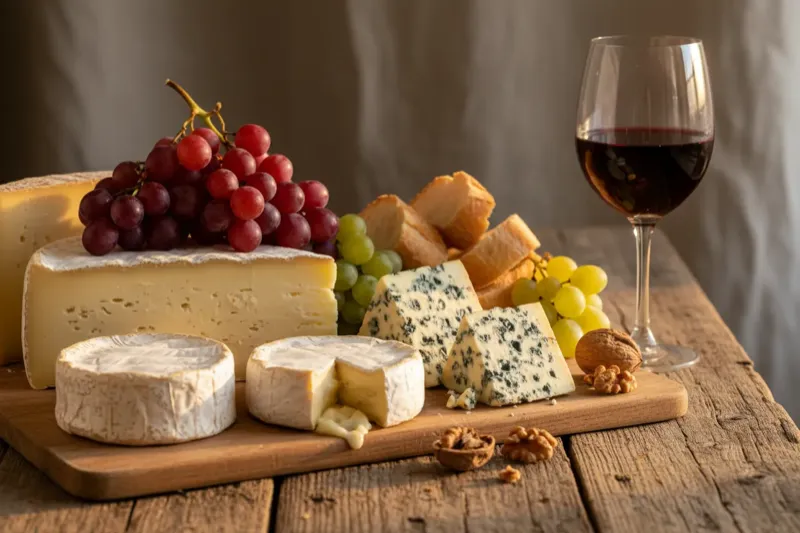
The French Paradox is one of the most studied phenomena in nutritional science, and after thirty years of research, I am going to tell you the conclusion most scientists have reached: it is not a paradox at all. It only looks like one if you believe that butter causes heart disease, that cheese makes you fat, and that wine is a health risk. French women eat all three — generously, joyfully, without a shred of guilt — and have an obesity rate less than half of America’s and significantly lower rates of cardiovascular disease. The “paradox” vanishes the moment you stop looking at individual foods and start looking at the complete French eating system. That is what this article is about.
I am Marion, and I have been living inside this so-called paradox my entire life without ever experiencing it as paradoxical. To me, there is nothing contradictory about eating butter and being slim. There is nothing mysterious about having wine with dinner and waking up healthy. These things only seem contradictory if your framework for understanding food is broken — and the American framework, I say this with love, is deeply broken.
Let me show you what the science actually says, updated for 2026, and why it matters for your own relationship with food.
The Original “Paradox” — And Why It Was Wrong From the Start
In 1991, a segment on 60 Minutes introduced America to the French Paradox. The question seemed straightforward: French people eat a diet rich in saturated fat — butter, cream, cheese, pate — yet have dramatically lower rates of heart disease. How?
The show focused on red wine as the answer. Resveratrol. Polyphenols. The French drink, and therefore they are protected. It was a seductive narrative. Wine sales in America jumped 44% in the weeks following the broadcast.
But the wine explanation was always incomplete. Resveratrol in the quantities found in wine has negligible cardiovascular effects — you would need to drink dozens of glasses daily to reach therapeutic doses. Subsequent studies confirmed that while moderate wine consumption correlates with cardiovascular benefits, the correlation is far too weak to explain the enormous gap between French and American health outcomes.
The real error was more fundamental. The question itself was wrong.
“How can they eat saturated fat and be healthy?” assumes saturated fat is the primary driver of heart disease and obesity. But the evidence for that claim has been crumbling for decades. A 2020 meta-analysis in the Journal of the American College of Cardiology reviewed 29 studies involving over 900,000 participants and found no significant association between saturated fat intake and cardiovascular disease or all-cause mortality.
When you remove the flawed premise, the paradox dissolves. French women eat butter and stay slim not despite the butter, but because butter was never the problem. The problem, as it turns out, was everything else about how Americans eat.
What Actually Explains French Health Outcomes
If it is not wine alone and it is not the absence of saturated fat, what is it? After reviewing the research — and living the answer for 35 years — I believe it is a system of at least six interlocking factors that are nearly impossible to study in isolation. That is why researchers kept looking for a single explanation and kept coming up short.
Factor 1: Meal Structure
French people eat three meals a day at consistent times. This is so culturally embedded that it barely registers as a health behavior — it is simply how life works. Breakfast around 7:30. Lunch at noon. Dinner at 7:30 or 8.
A 2016 study in Proceedings of the Nutrition Society found that regular meal timing is independently associated with lower BMI, better insulin sensitivity, and improved cardiovascular markers — regardless of what is being consumed. The regularity itself is protective.
Americans eat erratically. A 2021 survey found that 53% of American adults eat at irregular times, and 90% snack between meals. This irregularity disrupts circadian metabolic rhythms, impairs insulin signaling, and creates a state of chronic low-level metabolic confusion.
French women stay slim without dieting partly because their bodies always know when the next meal is coming. There is no metabolic panic. No hoarding response. Just rhythm.
Factor 2: Eating Speed
The average French meal lasts 33 minutes. The average American meal lasts 11 minutes. This is perhaps the most underappreciated factor in the entire paradox.
As I explore in detail in the science of slow eating, eating slowly increases satiety hormones GLP-1 and PYY by 25-30%. French women feel fuller from the same amount of food because they eat it at a pace that allows their biology to function. Americans eat so quickly that their satiety signals never arrive before the meal is over.
This factor alone could explain a meaningful portion of the difference in obesity rates. It costs nothing. It requires no special food. It simply requires time.
Factor 3: Portion Norms
French portions are 25-40% smaller than American portions. This has been documented across restaurants, packaged foods, and home cooking. A Cornell University study found that the average Parisian restaurant plate was 25% smaller by area than the average Philadelphia restaurant plate, and French packaged foods averaged 40% smaller.
But French people do not perceive themselves as eating less. In survey after survey, French participants rate their portion sizes as “normal” and their meals as “satisfying.” The smaller portions feel right because the food is rich, flavorful, and eaten slowly enough to register fully.
This is a critical distinction. The difference between French and American eating is not that French women eat less by exercising discipline. They eat less because they are satisfied sooner. The system produces the moderation automatically.
Factor 4: Food Quality Over Food Quantity
The French spend more on food than Americans — both in absolute terms and as a percentage of income. According to USDA and INSEE data, the average French household spends roughly 20% of its budget on food, compared to 10% for American households.
This is not a waste of money. It is an investment in satisfaction. When your cheese is excellent, you need less of it. When your bread is fresh from a boulangerie, two pieces are enough. When your chocolate is dark and complex, three squares do what an entire candy bar cannot.
Cheap food leads to more eating. When food does not satisfy — when it is engineered for shelf life rather than flavor, when it is stripped of fat and pumped with sugar — you eat more of it searching for a satisfaction that never arrives. This is the American trap. The French escaped it by spending more on less.
Factor 5: Walking Culture
The average French person walks 8,100 steps per day. The average American walks 4,800. This difference — roughly 3,300 steps, or about 25 minutes of walking — may sound trivial. It is not.
A 2023 meta-analysis in the European Journal of Preventive Cardiology found that every additional 1,000 steps per day is associated with a 15% reduction in all-cause mortality. At 3,300 additional steps daily, the French are buying themselves roughly a 45% mortality reduction through walking alone.
But walking does more than burn energy. It regulates blood sugar after meals, reduces cortisol, improves insulin sensitivity, and supports cardiovascular function through gentle, sustained aerobic activity. The French do not think of walking as exercise. It is transportation, pleasure, and social life. That is why they do it every day, forever.
Factor 6: The Absence of Food Guilt
This factor is invisible in the data, but I believe it is the most important of all.
Paul Rozin’s landmark research at the University of Pennsylvania compared food attitudes across cultures and found that American women associated food with worry, guilt, and health anxiety, while French women associated food with pleasure, celebration, and social connection. And the pleasure-focused eaters were healthier.
Guilt does not make you eat less. It makes you eat more. The restriction-guilt-binge cycle is well-documented in eating psychology research. French women avoid this cycle entirely because they never enter it. There is no forbidden food. There is no “being good” or “being bad.” There is just food.
This connects to the broader principle of mindful eating that French women practice naturally — eating with attention and without moral judgment.
The Butter and Cheese Question
Let me address this directly because I know it is what many of you came here wondering about.
French women eat approximately 26 kg of cheese per person per year — among the highest consumption rates in the world. They cook with butter routinely. They eat cream sauces, pate, full-fat yogurt, and croissants.
And they are healthier than American women who avoid all of these things.
Here is what I think is happening, supported by the research:
First, the dose matters. French cheese consumption is frequent but moderate. A typical serving is 30-40 grams — roughly the size of two dice. It is eaten after a meal, slowly, with attention. It is not a 200-gram block of cheddar eaten as a snack while watching television. Frequency is high. Volume per occasion is small.
Second, fermented dairy may be protective. A growing body of research, including a 2021 meta-analysis in Advances in Nutrition, suggests that fermented dairy products (cheese, yogurt, kefir) are associated with reduced cardiovascular risk, even compared to non-fermented dairy. The fermentation process produces bioactive peptides, probiotics, and vitamin K2 that may actively support heart health.
Third, dairy fat in the context of a complete meal behaves differently than dairy fat in isolation. When you eat cheese at the end of a structured, vegetable-rich, slowly consumed French meal, the fiber, polyphenols, and other nutrients modulate how your body processes the fat. Eating a chunk of cheese alone on an empty stomach is a completely different metabolic event.
Fourth, and perhaps most importantly, the French do not eat cheese instead of vegetables. They eat cheese in addition to vegetables, salads, fruits, legumes, and olive oil. Their overall dietary pattern is rich in protective compounds. The cheese is one note in a complex chord, not a solo.
Has the French Paradox Changed Over Time?
This is a fair question. France is not immune to globalization, fast food, and ultra-processed products. McDonald’s France is actually the company’s most profitable market outside the United States. Obesity rates in France have risen from 8% in 1997 to 17% in 2024.
But the gap persists. American obesity has risen even faster, from 30% to 42% in the same period. And the core French food culture — structured meals, real ingredients, slow eating, walking — remains intact for the majority of the population, even as processed food makes inroads.
What has changed is our understanding. In the 1990s, researchers looked for a single magic bullet — wine, fat type, genetics. Today, the scientific consensus recognizes that the “paradox” is actually a lifestyle system made up of dozens of small, compounding habits.
A 2022 review in Nutrients concluded: “The French Paradox is better understood not as a contradiction but as evidence that dietary patterns, meal context, and eating behaviors may be more important than individual nutrient composition.”
That is exactly what I have been saying from the beginning.
What This Means for You
If you are an American woman reading this, you do not need to become French. You do not need to move to Paris or shop at a fromagerie or learn to make bearnaise sauce.
You need to build a system. Not swap one food for another. Not add wine and hope for the best. A system of habits that work together the way French habits do.
Here is what the paradox actually teaches us, distilled into actionable principles:
1. Stop fearing whole foods. Butter, cheese, olive oil, bread, wine — these are not the enemy. The enemy is eating without structure, without attention, and without pleasure. Give yourself permission to eat real, rich, satisfying food. This alone will change more than any elimination ever could.
2. Build meal structure. Three meals. Consistent times. Sit down. Start with something light. Take at least 20 minutes. End with something satisfying. This framework does more for your body than any macronutrient ratio ever will.
3. Walk. Not to a gym. Not to burn something off. Walk because it is pleasant. Walk after dinner. Walk to the store if you can. Walk through your neighborhood and notice the sky. Make it daily. Make it effortless. Make it the one form of movement you will never quit.
4. Spend more on less food. Buy the good olive oil. Buy the cheese that costs twice as much but tastes five times better. Buy the bread from the bakery instead of the shelf. You will eat less of it because it satisfies you. And your grocery bill will likely stay the same — you are spending more per item but buying fewer items.
5. Remove the moral framework from eating. No food is good. No food is bad. You are not good for eating salad or bad for eating cake. You are a human being having a meal. The day you remove morality from your plate, you remove the guilt-binge cycle that drives overeating. The paradox was never about food chemistry. It was about food peace.
The Paradox Is the Answer
I want to leave you with this thought.
The French Paradox was always framed as a question: “How can this be?” But the answer was embedded in the question all along. The things we thought were the problem — butter, cheese, wine, pleasure — were actually part of the solution. When eaten in the right context — structured meals, small portions, slow pace, full attention, no guilt — these foods do not undermine health. They support it.
The real paradox is somewhere else entirely. It is the American paradox: how can a culture so obsessed with health be so unhealthy? How can people who think about food constantly, who track every bite, who have an entire industry built around eating less, be gaining more?
The answer is the same in both cases. Pleasure, structure, and peace with food produce health. Fear, restriction, and guilt produce disease. The science has caught up with what French grandmothers have always known.
You do not need to solve a paradox. You need to stop creating one.
Ready to adopt the French eating system that makes the “paradox” possible? Download my free guide: The French Alternative to Ozempic. It walks you through the complete framework — meal structure, food choices, timing, and the pleasure principle — so you can start eating with joy and without guilt. No medication. No restriction. Just the system French women have used for generations.
Want the full French approach?
Get my free guide: "The 7 Habits That Naturally Trigger GLP-1"
Frequently Asked Questions
Has the French paradox been debunked?
No, but it has been reframed. The original paradox — 'how can French people eat saturated fat and have low heart disease?' — was based on a flawed assumption that saturated fat alone causes disease. Modern research shows the paradox disappears when you account for French meal structure, eating speed, portion norms, walking culture, and pleasure-based eating. It was never a paradox — it was a lifestyle system researchers failed to measure.
Is the French paradox still true?
The underlying observation remains true in 2026: France's obesity rate is 17% vs. America's 42%, and French heart disease rates are significantly lower, despite higher consumption of butter, cheese, and wine. What has changed is the explanation — scientists now understand it is not one factor but a complete system of eating habits, meal timing, and daily movement.
Why does France have such low heart disease?
France's lower heart disease rates result from a combination of factors: structured meals eaten slowly (boosting satiety and reducing overeating), high consumption of polyphenol-rich foods (wine, olive oil, vegetables), daily walking averaging 8,000+ steps, smaller portions of higher-quality food, and lower rates of chronic stress eating. No single food explains it — the system does.
Why do French people eat so much cheese and stay thin?
French cheese consumption is high in frequency but moderate in quantity — a small serving of excellent cheese after a meal, not a snack eaten by the handful. Combined with structured meals, slow eating, and daily walking, the cheese becomes part of a system that naturally regulates appetite and body weight.