7 French Foods That Work Like Ozempic (Without the Side Effects)
These 7 French kitchen staples naturally boost GLP-1 — the same hormone Ozempic mimics. Science-backed, delicious, and available at your grocery store.
 By Marion ·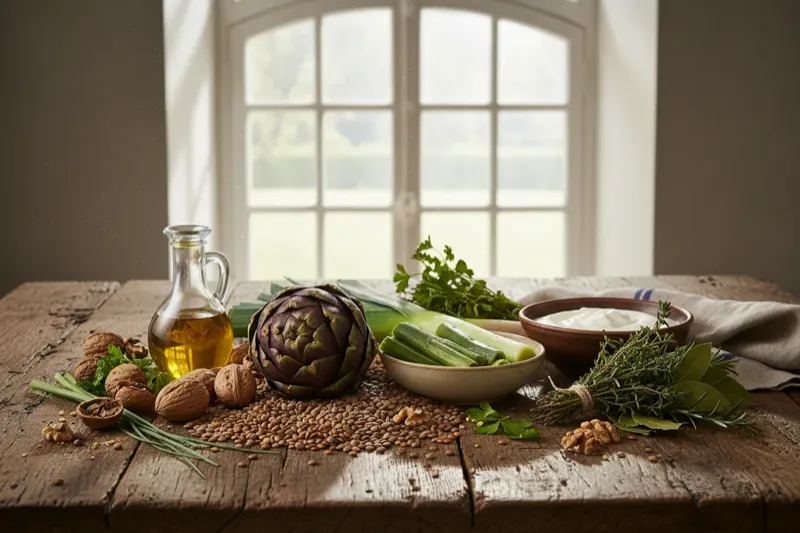
Medical Disclaimer
This content is for educational purposes only and is not medical advice. Ozempic (semaglutide) is a prescription medication. Consult your healthcare provider before making any changes to your medication or diet.
7 French Foods That Work Like Ozempic (Without the Side Effects)
Lentils, artichokes, olive oil, yogurt, aged cheese, leeks, and dark chocolate — these seven French kitchen staples naturally boost GLP-1, the exact hormone that Ozempic mimics to suppress appetite. You don’t need a prescription. You don’t need $1,300 a month. You need a trip to the grocery store and a willingness to eat the way French women have eaten for centuries. Every one of these foods is backed by published research, and together, they form a natural GLP-1 boosting system that could change your relationship with hunger forever.
I’m Marion, and when I first learned how Ozempic works, I had a moment of genuine surprise. Not because the science was new to me — but because it described what was already on my dinner table.
GLP-1 (glucagon-like peptide-1) is a hormone your body produces naturally in the gut. It slows gastric emptying, signals satiety to the brain, and regulates blood sugar. Ozempic is a synthetic version of this hormone. It works brilliantly — but it’s a drug that costs a fortune, comes with side effects, and requires indefinite use for sustained results.
What if you could boost your body’s own GLP-1 production through food?
You can. And French women have been doing it without knowing the science. Here are the seven foods that form the core of this natural approach.
1. Lentilles du Puy (French Green Lentils)
If I had to choose one food that comes closest to mimicking Ozempic’s effect, it would be lentils.
Les lentilles du Puy — small, dark green lentils from the Auvergne region — are a cornerstone of French home cooking. We eat them in salads, soups, as a warm side with mustard vinaigrette, alongside sausages, or simply with a drizzle of olive oil and fresh herbs.
The science is remarkable. A study published in The British Journal of Nutrition (2017) found that a single serving of lentils reduced subsequent meal food intake by 22% and lowered blood glucose response. The mechanism? Lentils are extraordinarily rich in both soluble fiber and resistant starch — two compounds that trigger sustained GLP-1 release.
Unlike simple carbohydrates that cause a GLP-1 spike and crash, lentils produce a slow, extended GLP-1 curve lasting 3-4 hours after eating. This means you feel genuinely satisfied for the entire period between meals. The food thoughts don’t return because your satiety hormones are still active.
How French women use them: Lentil salad with Dijon mustard, shallots, and olive oil. Takes 20 minutes. Costs almost nothing. Keeps you satisfied until dinner.
2. Artichokes (Including Jerusalem Artichokes)
Artichokes are deeply embedded in French cuisine — from the globe artichokes we eat with vinaigrette to the topinambours (Jerusalem artichokes) that appear in soups and gratins throughout winter.
What makes artichokes special is inulin — a prebiotic fiber that feeds the specific gut bacteria (Bifidobacteria and Lactobacilli) responsible for GLP-1 production. A 2015 study in the American Journal of Clinical Nutrition found that inulin supplementation increased GLP-1 levels by 20-33% over a 12-week period.
But here’s what’s important: getting inulin from whole artichokes is more effective than supplements. Whole food delivers the inulin alongside other fibers, polyphenols, and nutrients that create a synergistic effect on gut health and GLP-1 production.
Jerusalem artichokes (topinambours) are particularly potent — they contain among the highest concentrations of inulin of any food. In France, we roast them, puree them into soup, or slice them raw into winter salads.
How French women use them: Globe artichoke with vinaigrette as a starter. Jerusalem artichoke soup in winter. Both prime the gut for enhanced GLP-1 production throughout the meal.
3. Extra Virgin Olive Oil
Olive oil is to French cooking what water is to swimming — it’s everywhere, and nothing works without it. We dress salads with it. We cook vegetables in it. We drizzle it on soups. We dip bread in it.
And every time we do, we’re triggering GLP-1 release.
The key compound is oleic acid, a monounsaturated fatty acid that makes up about 70% of olive oil. A study in The Journal of Endocrinology demonstrated that oleic acid directly activates GPR40 and GPR120 receptors in the gut, which are the primary triggers for GLP-1 secretion.
A separate study in Diabetes Care found that adding olive oil to a meal significantly increased postprandial GLP-1 levels compared to the same meal without olive oil. The subjects also reported feeling fuller for longer.
This is why low-fat diets backfire so spectacularly. When you remove fat — especially olive oil — from your meals, you remove one of the most powerful natural GLP-1 triggers. You feel less satisfied. You think about food more. And you end up eating more overall. If you want to understand more about the connection between these foods and the French alternative to Ozempic, this is the key piece most people miss.
How French women use it: Generously. On everything. The French consume an average of 1.5-2 tablespoons of olive oil per day. Not as a health supplement — as flavor. It makes food taste better and it makes you feel fuller. That’s not a tradeoff. That’s a gift.
4. Full-Fat Natural Yogurt
Walk into any French supermarket and you’ll see an entire aisle dedicated to yogurt. Not the American kind — not fat-free, not artificially sweetened, not loaded with fruit puree. Just plain, full-fat, natural yogurt. Yaourt nature.
French women eat this daily. Often after dinner, sometimes with a drizzle of honey or a few berries. It’s not dessert and it’s not diet food. It’s just… food.
And it’s a dual GLP-1 weapon.
First, the protein in yogurt (particularly whey protein) stimulates GLP-1 release. A 2009 study in The American Journal of Clinical Nutrition found that dairy protein was among the most effective food proteins for triggering GLP-1 secretion.
Second, the probiotics in natural yogurt — particularly Lactobacillus and Bifidobacterium strains — directly enhance GLP-1 production by improving the gut environment where GLP-1 is manufactured. A 2020 meta-analysis in Nutrients found that regular consumption of fermented dairy was associated with significantly higher baseline GLP-1 levels.
The fat matters too. Full-fat yogurt delivers the fatty acids that activate the same gut receptors as olive oil. Fat-free yogurt strips out this mechanism entirely.
How French women use it: A small pot of plain yogurt after dinner, maybe with a spoonful of honey. Simple. Satisfying. And quietly boosting GLP-1 while you sleep.
5. Aged, Fermented Cheese
Yes. Cheese. I know this might seem counterintuitive if you’ve been raised in American diet culture, but cheese is a legitimate appetite-regulating food — specifically aged, fermented cheeses like Comte, Roquefort, Camembert, and Brie.
French women eat cheese at almost every meal. A small portion, usually after the main course, before or instead of dessert. Not a mountain of cheddar on nachos — a few pieces of quality cheese, eaten slowly, with attention.
The science here involves three mechanisms:
Conjugated linoleic acid (CLA): Found abundantly in cheese from grass-fed cows, CLA has been shown to improve insulin sensitivity and reduce fat storage. A 2000 study in The Journal of Nutrition demonstrated that CLA modulates adiposity and energy metabolism.
Butyrate: Aged cheeses produce butyrate, a short-chain fatty acid that directly stimulates GLP-1 producing L-cells in the gut. A 2012 study in Diabetes showed that butyrate supplementation enhanced GLP-1 secretion by 30%.
Tyramine and casein peptides: These compounds found in aged cheese interact with satiety signaling pathways, promoting the feeling of having completed a satisfying meal.
The “cheese course” effect: In France, cheese comes at the end of the meal. This is not accidental. A small, flavorful, fat-rich food at the meal’s end triggers a powerful satiation signal. It tells your brain: “The meal is complete. We can stop thinking about food now.” This is sensory-specific satiety at its most elegant.
How French women use it: 30-40 grams (about an ounce) of good cheese after the main course. With a piece of bread. Slowly. This is the period that ends the meal and closes the curtain on food thoughts.
6. Leeks (Poireaux)
The leek is the most underrated vegetable in French cooking and possibly the most underrated GLP-1 booster on this list.
La soupe aux poireaux — leek soup — is practically a national institution. Simple, cheap, and profoundly satisfying. French women have a saying that leek soup is their beauty secret. It’s also, as science now shows, an appetite-regulating powerhouse.
Leeks are rich in fructans — a type of prebiotic fiber closely related to the inulin found in artichokes. Fructans feed beneficial gut bacteria that produce short-chain fatty acids, which in turn stimulate GLP-1 secretion. A study in the European Journal of Clinical Nutrition found that increased fructan intake significantly enhanced satiety and reduced subsequent food intake.
Leeks also contain kaempferol, a flavonoid that has been shown in laboratory studies to enhance GLP-1 secretion from intestinal L-cells. While human studies are still emerging, the epidemiological data from French dietary patterns is suggestive.
The soup effect: When leeks are consumed as soup, you get the additional benefit of volume. Warm liquid stretches the stomach gently, activating stretch receptors that trigger an early satiety signal. You begin feeling satisfied before the GLP-1 from the fructans even kicks in. By the time it does, you’re deeply, peacefully full.
How French women use it: Leek and potato soup (soupe poireaux-pommes de terre) as a weeknight dinner starter. Leek vinaigrette (poireaux vinaigrette) as a cold starter in spring. Leeks braised in butter as a side dish. Always simple. Always satisfying.
7. Dark Chocolate (70%+ Cacao)
I saved this for last because I know it will make you smile. Yes, French women eat chocolate. Regularly. Usually a square or two of dark chocolate after lunch or dinner.
And the science supports them.
Dark chocolate (70% cacao or higher) contains flavanols that have been shown to modulate GLP-1 secretion. A 2017 study in the Journal of Functional Foods found that cocoa flavanols significantly increased GLP-1 levels and improved insulin sensitivity in healthy adults.
The theobromine in dark chocolate also promotes satiety through serotonin pathways. Unlike sugar-heavy milk chocolate, dark chocolate triggers satisfaction without the blood sugar spike and crash that leads to more cravings.
But perhaps most importantly, dark chocolate serves a psychological function. A small piece of intensely flavored chocolate at the end of a meal provides a definitive sensory endpoint. It is the period at the end of the sentence. The meal is over. The sweetness is done. Your brain registers completion.
How French women use it: One to two squares of good dark chocolate, broken off slowly, eaten with attention. Not a whole bar. Not while watching TV. Just a moment of concentrated, bittersweet pleasure.
The Compound Effect: Why These Foods Work Better Together
Individually, each of these seven foods has a measurable effect on GLP-1. But the French advantage comes from eating them together, within a structured meal system.
Consider a typical French dinner:
- Soupe aux poireaux (leek soup) as a starter — fructans prime the gut, volume activates stretch receptors
- Poulet aux lentilles (chicken with lentils) — protein triggers GLP-1, resistant starch extends the satiety curve
- A small salad dressed with olive oil — oleic acid activates gut receptors
- A piece of Comte cheese with bread — butyrate and fat deliver the meal completion signal
- A square of dark chocolate — flavanols boost GLP-1 one final time, sensory closure
Every course in this meal is doing GLP-1 work. The satiety signals overlap and compound. By the time you finish, your body has produced a sustained, multi-pathway satiety response that rivals what Ozempic does with a single mechanism.
And you did it for the cost of groceries. While enjoying every bite.
If you want to learn how to increase GLP-1 naturally with French foods, I go into even more detail on the daily meal frameworks and timing.
How to Start: Your French GLP-1 Shopping List
You don’t need a specialty store. Everything here is available at a standard American grocery store.
Buy this week:
- Green or French lentils (dried, canned — either works)
- Artichoke hearts (canned or frozen are fine to start)
- Extra virgin olive oil (the best you can afford — flavor matters)
- Full-fat plain yogurt (no added sugar, no flavoring)
- A piece of aged cheese (Parmesan, aged cheddar, Gruyere — anything fermented and aged)
- Leeks (usually in the produce section near onions)
- Dark chocolate, 70% or higher
This week’s challenge: Include at least three of these foods in each of your three daily meals. Notice how your appetite shifts. Notice how the food noise changes. Most women report a difference within three to four days.
The Bigger Picture
These seven foods are not magic bullets. They are ingredients in a larger system — a system that includes how you eat (slowly, seated, with attention), when you eat (structured meals, no grazing), and why you eat (pleasure, nourishment, social connection).
If you want to understand the complete system — not just the foods, but the rituals, the timing, and the mindset — read about the full French alternative to Ozempic. The foods are the foundation. The lifestyle is the architecture.
A note on medical decisions: If you’re considering Ozempic or currently taking it, please work with your doctor. These foods can complement medical treatment, but they are not a substitute for prescribed medication. Your health decisions should always be made with professional guidance.
Ready to build your French GLP-1 kitchen? Download my free guide — it includes complete meal plans, recipes, and a week-by-week framework for naturally boosting your satiety hormones the French way.
Bisous, Marion
Want the full French approach?
Get my free guide: "The 7 Habits That Naturally Trigger GLP-1"
Frequently Asked Questions
What foods can mimic Ozempic?
Foods rich in fiber, healthy fats, and fermented compounds can mimic Ozempic's GLP-1 boosting effect. Lentils, artichokes, olive oil, full-fat yogurt, fermented cheese, leeks, and dark chocolate have all been shown in studies to naturally stimulate GLP-1 production, the same hormone Ozempic artificially mimics.
What foods give the same fullness as Ozempic?
Lentils, artichokes, and olive oil produce the strongest natural satiety response similar to Ozempic. Lentils boost GLP-1 for up to 4 hours after eating, while olive oil's oleic acid directly triggers GLP-1 release in the gut. Combining these foods in a single meal amplifies the effect.
What foods are naturally like Ozempic?
Foods that are naturally like Ozempic are those that stimulate GLP-1 production in the gut. French staples like lentilles du Puy, Jerusalem artichokes, extra virgin olive oil, natural yogurt, aged cheese, leeks, and dark chocolate all contain compounds scientifically shown to boost GLP-1 levels naturally.
What drink mimics Ozempic?
No single drink mimics Ozempic's full effect, but certain beverages support GLP-1 production. Green tea contains EGCG which modestly boosts GLP-1 levels. Bone broth provides amino acids that stimulate satiety hormones. Kefir combines probiotics and protein for enhanced GLP-1 release. However, whole foods deliver a far stronger effect than any drink.