The French Fermented Foods Guide: How Cheese, Wine, and Yogurt Support Weight Loss
French women eat cheese, drink wine, and enjoy yogurt daily -- and stay slim. The science of fermented foods, GLP-1, and natural weight management explained.
 By Marion ·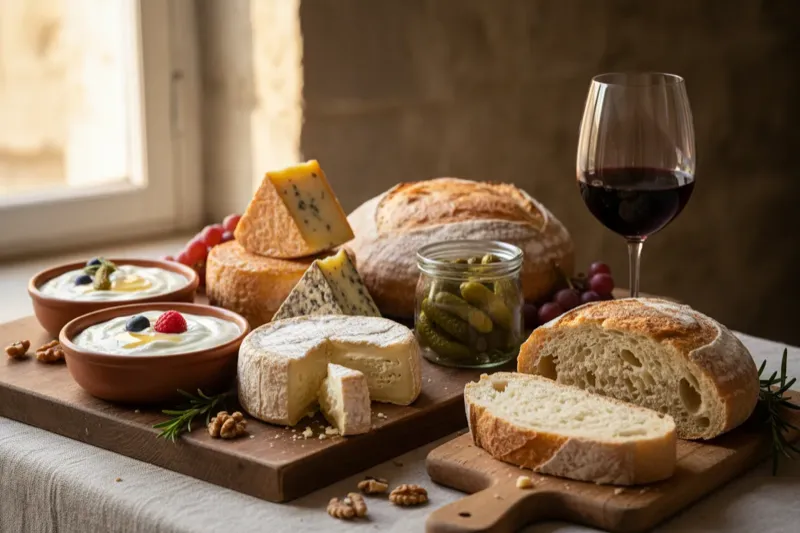
Medical Disclaimer
This content is for educational purposes only and is not medical advice. Ozempic (semaglutide) is a prescription medication. Consult your healthcare provider before making any changes to your medication or diet.
Yes, fermented foods can help you lose weight — but not because they burn fat or speed up metabolism. They work by rebuilding the gut ecosystem that produces GLP-1, your body’s own appetite-regulating hormone. And here’s the part that makes me smile as a French woman: the fermented foods with the strongest scientific evidence are cheese, yogurt, wine, sourdough bread, and pickled vegetables. The exact foods French women eat every single day. The exact foods American diet culture told you to avoid. The science of natural GLP-1 foods keeps circling back to the French kitchen, and fermented foods are the reason why.
My name is Marion. I grew up in a home where cheese appeared at every dinner, yogurt was breakfast, sourdough bread was the default, and wine was simply part of adult life. Nobody called these foods “health foods.” Nobody called them “superfoods.” We called them dinner.
Now the research is catching up to what French grandmothers always knew. The foods American women have been told to eliminate are the very foods that build the biological foundation for natural appetite control.
The Fermented Foods Paradox: Why French Women Eat “Everything Bad” and Stay Slim
Let me address the elephant in the room. If you’ve been raised on American nutritional advice, you were probably told:
- Cheese is fattening
- Wine adds empty weight
- Yogurt is only okay if it’s fat-free
- Bread is the enemy
- Pickled foods are “just sodium”
French women eat all of these, daily, and have an obesity rate of 17%. America restricts all of them and has an obesity rate of 42%.
This is not a coincidence. And it’s not genetics. It’s microbiology.
The emerging science of the gut microbiome has revealed something that rewrites everything we thought we knew about weight management: your gut bacteria determine, in large part, how much natural GLP-1 your body produces. And the single most effective way to build a GLP-1-producing gut is to eat fermented foods regularly.
France has been running this experiment for centuries. The data speaks for itself.
How Fermented Foods Trigger GLP-1 (The Science)
Let me walk you through the mechanism, because understanding it changes everything.
Step 1: You eat a fermented food — cheese, yogurt, sourdough, wine, cornichons.
Step 2: The live bacteria and fermentation compounds reach your gut, where they interact with your existing microbiome. Some bacteria colonize. Others produce metabolites that feed beneficial resident bacteria.
Step 3: These beneficial bacteria ferment fiber and other compounds, producing short-chain fatty acids (SCFAs) — particularly butyrate, propionate, and acetate.
Step 4: SCFAs bind to GPR41 and GPR43 receptors on intestinal L-cells, directly stimulating GLP-1 release. This is the exact same hormone Ozempic mimics.
Step 5: GLP-1 signals your brain to reduce appetite, slows gastric emptying so you feel satisfied longer, and improves insulin sensitivity.
This is not a single-meal effect. It’s a cumulative, compounding process. Each day of fermented food consumption builds a slightly more diverse, slightly more GLP-1-productive gut. Over weeks and months, the baseline shifts. Your body produces more GLP-1 from the same foods. Your natural appetite regulation strengthens.
A landmark 2021 study from Stanford University, published in Cell, assigned participants to either a high-fermented-food or high-fiber diet for 10 weeks. The fermented food group showed dramatically increased microbial diversity and significantly reduced markers of inflammation — both of which are associated with improved GLP-1 production and metabolic health. The fiber group showed no such improvement in diversity.
The researchers concluded that fermented foods are uniquely effective at reshaping the gut microbiome — more effective than fiber alone.
The French Fermented Five: Your Daily GLP-1 Arsenal
Let me introduce you to the five fermented foods that define French eating — and the science behind each one.
1. Cheese — The Misunderstood Metabolic Ally
I cannot tell you how many American women have told me they “gave up cheese to lose weight.” This may be the most counterproductive dietary decision in modern nutrition.
French cheese — particularly aged varieties like Comte, Roquefort, Camembert, and chevre — is alive with beneficial bacteria. These bacteria survived the aging and fermentation process, and they bring with them enzymes, peptides, and metabolites that profoundly influence your gut.
A 2019 study in Nature Medicine found that regular cheese consumption was not associated with weight gain and was, in fact, correlated with improved gut microbial diversity. The researchers hypothesized that the fermentation compounds in aged cheese — particularly the bioactive peptides produced during aging — have direct metabolic benefits.
The French cheese ritual matters too. In France, cheese is eaten after the main course, in small quantities, savored slowly. A thin slice of Comte. A sliver of Roquefort. This isn’t a cheese-laden casserole or a cheese-smothered burger. It’s a small, intensely flavorful serving that provides maximum microbial benefit with appropriate portion.
Cheese after a meal also serves a GLP-1 purpose: the additional protein and fat extend the satiety signal from the meal. French women leave the table feeling fully, peacefully satisfied — and that satisfaction lasts for hours.
Your action: Have a small serving of real, aged cheese (not processed cheese) after lunch or dinner. Comte, Gruyere, aged cheddar, Parmesan, goat cheese, blue cheese — choose one you genuinely love. Eat it slowly. This is your daily dose of microbial medicine.
2. Yogurt — The Morning GLP-1 Primer
In France, yogurt is not a “diet food.” It’s not fat-free, sugar-loaded, artificially flavored Greek yogurt in a squeeze tube. French yogurt is full-fat, plain, and often eaten with nothing more than a drizzle of honey or a few berries.
This matters because the live cultures in yogurt — Lactobacillus, Bifidobacterium, Streptococcus thermophilus — are among the most well-studied GLP-1-supporting bacteria. A 2020 study in Nutrients found that participants who consumed two servings of fermented dairy per day for 12 weeks had significantly higher fasting GLP-1 levels compared to a control group.
Higher fasting GLP-1 means your baseline appetite is lower. Before you’ve eaten a single bite, your body is already producing more satiety signaling. This is the cumulative effect of daily fermented food consumption — it raises the floor.
Your action: Replace your breakfast yogurt (if you eat one) with full-fat, plain yogurt. Add a drizzle of honey, a few walnuts, some fresh fruit. If you don’t eat yogurt, add a small bowl as part of your breakfast ritual. The live cultures begin their work within hours.
3. Wine — The Polyphenol Question
I know. Wine and weight loss in the same sentence sounds like wishful thinking. But the science is more nuanced than either the “wine is healthy” camp or the “all alcohol is poison” camp would have you believe.
Moderate red wine consumption — one small glass with dinner, the French standard — provides a concentrated dose of polyphenols, particularly resveratrol and quercetin. These polyphenols have been shown in multiple studies to enhance gut microbial diversity and specifically to support the growth of Akkermansia muciniphila, one of the most potent GLP-1-stimulating bacterial strains known to science.
A 2020 study published in Gastroenterology found that moderate red wine drinkers had significantly greater gut microbial diversity than non-drinkers or heavy drinkers. The key word is moderate. One glass. With food. As part of a meal, not as a standalone activity.
In France, wine is never consumed alone on an empty stomach. It accompanies food. It’s sipped slowly during a 30-to-45-minute meal. The polyphenols interact with the food in your gut, amplifying the fermentation process and supporting the bacteria that produce GLP-1.
I want to be clear: I am not suggesting you start drinking wine for weight loss. If you don’t drink, don’t start. You can get similar polyphenols from dark berries, dark chocolate, olive oil, and green tea. But if you already enjoy a glass of wine with dinner and have been told to stop because of your weight, the science suggests that modest, meal-paired red wine consumption is neutral to beneficial for gut health and appetite regulation.
Your action: If you drink wine, enjoy a small glass with dinner — slowly, with food. If you don’t, focus on other polyphenol sources: a square of dark chocolate, a handful of berries, a cup of green tea.
4. Sourdough Bread — The Fermented Carb
American diet culture’s war on bread has been one of its greatest errors. But not all bread is equal, and this distinction matters.
Traditional French bread is naturally fermented. A real baguette is made with flour, water, salt, and wild yeast — no commercial yeast, no preservatives, no added sugar. Pain de campagne and pain au levain (sourdough) undergo long fermentation that transforms the grain in ways that matter for your gut.
The fermentation process in sourdough bread partially breaks down gluten, produces organic acids that feed beneficial gut bacteria, and creates prebiotic compounds that support the microbiome. A 2017 study in Cell Metabolism found that sourdough bread produced lower glycemic responses and better metabolic markers than commercial white bread in a majority of participants — but only for those whose gut microbiome had the right bacterial composition.
This is the key insight: sourdough bread feeds the bacteria that help your body regulate appetite. Commercial bread, with its rapid-rise yeast and added sugars, does not.
In France, bread accompanies every meal. But it’s real bread, made the slow way, with natural fermentation. And it’s eaten as part of a complete meal — not as a vehicle for loading up on processed spreads.
Your action: Switch from commercial bread to sourdough or artisan bread made with natural fermentation. Check the ingredients: flour, water, salt, and starter or wild yeast. If there’s a list of chemicals you can’t pronounce, it’s not real bread.
5. Cornichons and Mustard — The Overlooked Condiments
These tiny pickled cucumbers and their constant companion, Dijon mustard, appear on French tables with such regularity that they’re invisible. But both are fermented, and both contribute to the daily microbial input that defines French eating.
Naturally fermented pickles (cornichons, not vinegar-brined gherkins) contain Lactobacillus strains that support gut diversity. Dijon mustard is made from ground mustard seeds fermented in verjuice (the juice of unripe grapes), producing unique bacterial metabolites.
These aren’t the main event. But they’re the supporting cast that makes the French gut ecosystem so robust. Every condiment, every side, every accompaniment adds another microbial voice to the chorus. The diversity itself is the point.
Your action: Keep cornichons and good Dijon mustard in your refrigerator. Serve cornichons alongside charcuterie, chicken, or with cheese. Use mustard in vinaigrettes and sauces. These small additions build microbial diversity over time.
The Gut-GLP-1 Connection: What the Stanford Study Really Means
I want to return to that Stanford study because its implications are profound.
For years, nutritional science focused on fiber as the key to gut health. “Eat more fiber” was the universal advice. And fiber is important — I’ve written about French fiber traditions and their role in appetite control. But the Stanford study revealed something unexpected.
The high-fiber group in the study did not see improved gut microbial diversity. Some participants’ guts actually became less diverse. The high-fermented-food group, however, saw consistent, significant increases in diversity across every participant.
The researchers’ conclusion: fermented foods are more effective at reshaping the gut microbiome than simply adding fiber. The ideal approach — which, unsurprisingly, is exactly what the French diet provides — is both: fermented foods AND high fiber.
When you eat a French meal — lentils dressed with mustard vinaigrette, alongside a piece of cheese, with sourdough bread — you’re getting both the fiber (lentils) and the fermented foods (mustard, cheese, bread) in a single sitting. The fiber feeds the bacteria. The fermented foods recruit new bacteria. Together, they build a GLP-1 factory that grows stronger with every meal.
This dual approach is what makes the French foods that work like Ozempic so effective. It’s never one ingredient. It’s the system.
What Fermented Foods Do to Food Noise
Beyond GLP-1, there’s an emerging and fascinating connection between the gut microbiome and the brain — the gut-brain axis. And this connection may explain why French women experience so much less food noise than American women.
Your gut bacteria produce neurotransmitters. Approximately 95% of your body’s serotonin is produced in the gut. Significant amounts of dopamine, GABA, and other mood-regulating compounds are also gut-produced. The composition of your microbiome directly affects the quantity and balance of these neurotransmitters.
A 2019 study in Nature Microbiology found that people with greater gut microbial diversity reported higher quality of life scores and lower rates of depression. Two specific bacterial genera — Coprococcus and Dialister — were consistently depleted in people with depression and low quality of life.
What feeds Coprococcus and Dialister? Fermented foods and prebiotic fiber. The French diet staples.
When your gut is producing adequate serotonin and dopamine through a healthy microbiome, your brain’s relationship with food normalizes. The obsessive food thoughts — the constant negotiation, the guilt, the planning — quiet down. Not because you’re suppressing them with medication, but because your brain chemistry is balanced enough that food returns to its proper place: nourishment and pleasure, not anxiety.
How to Build Your French Fermented Food Ritual
You don’t need to eat everything at once. You need to build consistency. Here is a practical framework.
Breakfast: Full-fat plain yogurt with honey, nuts, or fruit. This is your morning probiotic foundation.
Lunch: Sourdough bread with your meal. A vinaigrette made with Dijon mustard and olive oil on your salad. If you like, a piece of cheese.
Dinner: A small glass of wine if you choose. A piece of cheese after the meal. Cornichons or pickled vegetables as a side.
That’s it. Six to eight servings of fermented foods per day, woven naturally into three meals. This is not a supplement protocol. This is not a complicated regimen. This is just French Tuesday.
Within two weeks, most women notice improved digestion. Within four weeks, appetite begins to shift — meals feel more satisfying, between-meal cravings soften. Within eight to twelve weeks, the gut microbiome has measurably diversified, and the GLP-1 baseline has risen.
This is the timeline that matters. Not the overnight fix of a drug, but the gradual rebuilding of a biological system that, once established, maintains itself indefinitely.
The Berberine Comparison
A quick note, because I know many women reading this are also exploring berberine as “nature’s Ozempic”. Berberine supplements have shown some GLP-1-boosting properties in studies, and I respect the science. But a berberine capsule doesn’t rebuild your gut microbiome. It doesn’t retrain your eating habits. It doesn’t address the cultural and behavioral patterns that create food noise.
Fermented foods do all of these things simultaneously. They boost GLP-1, diversify your microbiome, improve your brain chemistry, and — critically — they taste extraordinary. They make meals more pleasurable, which increases satisfaction, which reduces the urge to eat between meals.
A berberine pill is an intervention. Fermented foods are a way of life. I know which one is sustainable.
A Note About “Diet” Fermented Foods
I want to warn you about something. The American food industry has noticed the fermented food trend and has responded by creating “probiotic” yogurts, “gut health” drinks, and “fermented” snack bars.
Most of these products are not what you need. They are often ultra-processed, loaded with artificial sweeteners (which damage gut microbiome diversity), and contain bacterial strains chosen for shelf stability rather than gut health. A “probiotic” yogurt with 28 grams of sugar and artificial flavoring is not the same as plain, full-fat French yogurt with live cultures.
The rule is simple: the fewer ingredients, the better. Real yogurt has milk and cultures. Real cheese has milk, cultures, salt, and rennet. Real sourdough has flour, water, salt, and starter. Real wine has grapes. If the ingredient list is longer than one line, it’s not a fermented food — it’s a processed product with a fermented marketing angle.
The French Fermented Advantage — And How to Claim It
Here is the truth that keeps me endlessly fascinated.
French women are not thin because they restrict. They are not slim because they exercise obsessively. They maintain their weight because their daily diet — built around cheese, yogurt, bread, wine, and fermented condiments — has constructed a gut microbiome that naturally produces high levels of GLP-1 and other satiety hormones.
They are, without knowing it, running a natural version of the pharmaceutical system that costs Americans $12,000 per year.
And this system is available to you. Not through a prescription. Not through a supplement. Through food. Real, fermented, delicious food that makes every meal better.
This is what I mean when I talk about increasing GLP-1 naturally. It’s not about hacks or shortcuts. It’s about rebuilding the biological foundation that makes appetite regulation effortless.
Ready to build your own French fermented food system? Download my free guide: “The French Alternative to Ozempic” — the complete framework for naturally boosting your GLP-1 production through French eating principles. Meal templates, food lists, and the science behind every recommendation. Your gut microbiome will thank you.
Bisous, Marion
Want the full French approach?
Get my free guide: "The 7 Habits That Naturally Trigger GLP-1"
Frequently Asked Questions
Can eating fermented foods help you lose weight?
Yes. A 2023 meta-analysis in The British Journal of Nutrition found that regular fermented food consumption was associated with lower body weight, reduced waist circumference, and improved metabolic markers. Fermented foods support weight management by improving gut bacteria diversity, which increases natural GLP-1 production -- the same satiety hormone Ozempic mimics.
What fermented foods release GLP-1?
Fermented dairy (yogurt, cheese, kefir), fermented vegetables (cornichons, sauerkraut), sourdough bread, and red wine all support GLP-1 production. They work by feeding beneficial gut bacteria -- particularly Akkermansia muciniphila -- that produce short-chain fatty acids, which directly stimulate GLP-1 release from intestinal L-cells.
Does fermented food speed up metabolism?
Fermented foods don't directly 'speed up' metabolism, but they improve metabolic efficiency. By enhancing gut microbiome diversity and increasing GLP-1 production, fermented foods improve insulin sensitivity, reduce inflammation, and optimize how your body processes and stores energy. The effect is cumulative over weeks and months.
What happens if you eat fermented foods every day?
A Stanford study found that eating fermented foods daily for 10 weeks significantly increased gut microbial diversity and reduced markers of inflammation. Over time, daily fermented food consumption builds a gut ecosystem that produces more natural GLP-1, leading to better appetite regulation and improved metabolic health.