The French Dessert Secret: How to Enjoy Sweets Without Food Guilt
French women eat chocolate and pastry daily without guilt or weight gain. The secret is HOW they eat it -- the psychology of pleasure, not restriction.
 By Marion ·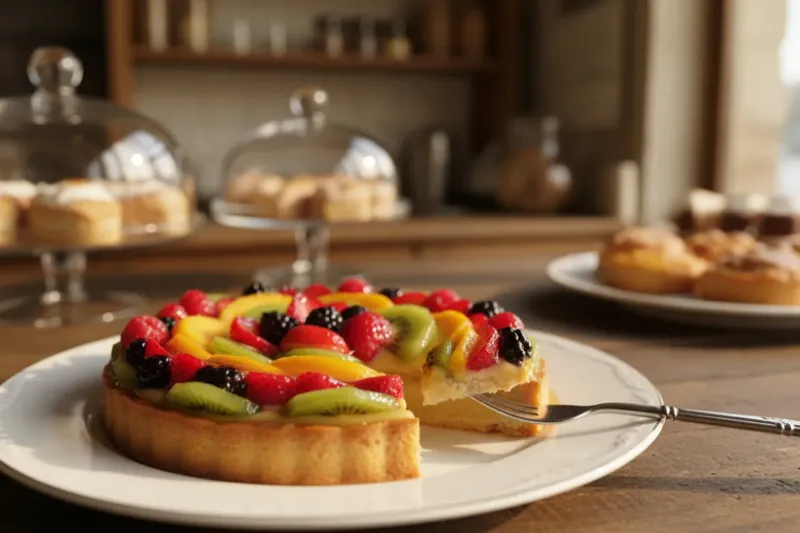
French women eat dessert every day — chocolate after lunch, a tarte on Sunday, a pastry from the bakery — and they do it without an ounce of guilt. The secret is not willpower, metabolism, or tiny portions measured with mathematical precision. It is a completely different psychology around sweets: one where pleasure is the point, not the problem. If you have spent years either depriving yourself of dessert or eating it and feeling terrible afterward, the French approach to intuitive eating will show you a third option you may never have considered. You can enjoy sweets. Fully. Daily. And feel nothing but satisfied.
I am Marion, and I eat chocolate every single day of my life. I have done this since I was a child. My mother does it. My grandmother did it. Every French woman I know does it. And none of us have ever used the phrase “I shouldn’t” before picking up a piece of chocolate. Because in France, chocolate is not a moral event. It is just chocolate.
The first time an American friend apologized to me for ordering dessert at a restaurant, I was genuinely confused. She said, “I know I shouldn’t, but…” and then ate her creme brulee with visible anxiety. I thought: what has been done to you? Who taught you that eating something beautiful and delicious is something to apologize for?
The Psychology of Guilt-Free Dessert
The French dessert secret is not a technique. It is a belief system. And it starts with one radical premise: there is no such thing as a food you should not eat.
When dessert is forbidden, it becomes powerful. The moment you label chocolate or cake or ice cream as “off-limits,” you create a psychological tension that builds until it explodes. You do not eat one cookie. You eat twelve, because this is your one chance before the restriction starts again Monday.
When dessert is permitted — when it is simply the last course of a meal, as ordinary as the salad that started it — that tension does not exist. You eat a serving. It is lovely. You move on.
Research by Dr. Janet Polivy at the University of Toronto, published in International Journal of Eating Disorders, documented what she calls the “what-the-hell effect.” Dieters who ate a food they considered forbidden were significantly more likely to overeat that food compared to non-dieters. The restriction itself caused the binge, not the food.
Eating without guilt is not about removing your conscience. It is about removing the false moral framework that turns eating into a crime.
Why French Women Eat Dessert Every Day
Let me tell you what dessert looks like in my life. Not the Instagram version. The real, boring, wonderful version.
After Lunch: Le Petit Plaisir
After my main course at lunch, I have something sweet. Most days, this is two squares of dark chocolate — 70% cacao, good quality, from the tablette I keep in the kitchen drawer. I break them off, I eat them slowly, I let them melt on my tongue. The whole experience takes about three minutes.
Sometimes it is a yogurt with a drizzle of honey. Sometimes a piece of fruit — a ripe pear in autumn, strawberries in June. Sometimes a small pot of chocolate mousse I made on Sunday.
The portion is small. Not because I am controlling it. Because I just ate a complete, satisfying meal with protein, fat, vegetables, and bread. I am already nearly full. The dessert is a closing note, not a second movement.
After Dinner: The Quiet Ritual
After dinner, which in France is lighter than lunch, dessert is even simpler. A piece of fruit is most common. An apple, sliced and eaten slowly. A clementine, peeled at the table. If someone has baked, a thin slice of tarte. If there is cheese, the cheese might be the dessert.
Sunday: The Exception That Proves the Rule
On Sundays, French families eat a larger, more elaborate meal. This is when the real patisserie comes out. A tarte aux fraises from the bakery. A Paris-Brest. A clafoutis made at home. Portions are generous — not absurdly so, but this is a celebration meal.
And here is the key: nobody “makes up for it” on Monday. Monday breakfast is the same as always. Monday lunch is the same as always. There is no compensatory restriction because there is nothing to compensate for. Sunday dessert is part of life, not a deviation from a plan.
The 20-Minute French Dining Rule
There is a biological mechanism that makes all of this possible, and French meal culture activates it perfectly without anyone ever thinking about it.
It takes approximately 20 minutes from the start of eating for your satiety hormones to reach meaningful levels. These hormones — cholecystokinin (CCK), peptide YY (PYY), and GLP-1 — are the chemical messengers that tell your brain “we have eaten enough.”
French meals last a minimum of 20-30 minutes for a weeknight dinner, and 45-90 minutes for a weekend lunch. By the time dessert arrives, your satiety system is fully engaged. Your brain has received the message that you have eaten well. The dessert is landing on a foundation of biological satisfaction.
This is why a French woman can eat two squares of chocolate and feel complete, while an American woman can eat an entire bar and feel unsatisfied. It is not about the chocolate. It is about everything that came before it.
A 2010 study in the Journal of Clinical Endocrinology and Metabolism found that eating slowly increased the release of satiety hormones by up to 25% compared to eating the same food quickly. Slow eating is not a trick. It is how your body is designed to work. French culture simply never overrode this design.
The Pleasure Paradox: Why Enjoying Dessert Makes You Eat Less
Here is the part that will feel counterintuitive if you have spent years in diet culture: the more you enjoy your dessert, the less you need.
This is not a paradox at all. It is straightforward neuroscience. When you eat something pleasurable — when you actually taste it, smell it, let it sit on your tongue — your brain receives a full dopamine signal. The pleasure circuit completes. Your brain says: “That was wonderful. We are done.”
When you eat the same food with guilt, shame, or while distracted, the pleasure circuit does not complete. You get a partial signal. Your brain says: “Something pleasurable happened but we did not fully register it. Keep going.”
This is why you can eat an entire bag of cookies while watching television and feel nothing afterward — not full, not satisfied, not pleased. You consumed the food but you did not eat it. You missed the pleasure, so your brain keeps searching.
A 2018 study in Appetite found that participants who were instructed to eat mindfully — paying attention to flavor, texture, and aroma — consumed 25% less food and reported significantly higher satisfaction than those who ate the same food while distracted. Pleasure is not the enemy of moderation. It is the mechanism of moderation.
Emotional eating and pleasure eating are different things entirely. One leaves you empty. The other leaves you complete.
The Quality Principle: Why French Chocolate Is Different
There is a practical dimension to this as well. French women do not eat any chocolate — they eat good chocolate.
My tablette of dark chocolate costs about four euros. It is made with cacao butter, not vegetable oil. It is 70% cacao, with a complex bitter-sweet flavor that evolves as it melts. It does not taste like sugar with brown coloring. It tastes like chocolate.
When your chocolate tastes extraordinary, two squares are a complete experience. When your chocolate tastes mediocre, your brain keeps searching for the satisfaction it was promised. You eat more because each piece delivers less.
This applies to every category of dessert. A tarte made with real butter pastry and fresh fruit satisfies differently than a mass-produced pie. A scoop of artisanal ice cream made with cream and egg yolks satisfies differently than a low-fat frozen dessert made with gums and stabilizers.
French women spend more per unit and eat less in volume. The math works out. And the experience is incomparably better.
How Diet Culture Ruined Dessert
Let me name what happened, because I think it is important to see it clearly.
Sometime in the last fifty years, American diet culture performed a kind of alchemy in reverse. It took one of life’s simplest pleasures — the sweetness at the end of a meal — and turned it into a source of shame, anxiety, and self-punishment.
It created “sugar-free” desserts that taste like cardboard and chemical sweetness. It invented the concept of “earning” dessert through exercise. It produced an entire generation of women who cannot eat a piece of cake at a birthday party without performing visible guilt for the table: “Oh, I’m so bad!” “I’ll start again Monday!” “Don’t let me have seconds!”
This performance is heartbreaking to me. These women are not enjoying the cake. They are enduring it. They are eating it quickly, barely tasting it, already planning how to compensate. The pleasure — the only thing that would actually satisfy them and allow them to stop — has been replaced by a transaction.
And then we wonder why American women struggle with food. You cannot have a healthy relationship with something you have been taught to fear.
The diet culture detox starts with one simple act: eating a piece of chocolate slowly, without apology, and letting yourself enjoy it completely.
5 Ways to Enjoy Dessert the French Way
You can start these today. Right now. With whatever sweet thing is in your kitchen.
1. Eat dessert at the end of a meal, not as a standalone event
When dessert follows a complete meal, your body is already approaching fullness. The sweet becomes a finishing note, not a main course. Two bites feel like enough because your body is already satisfied. Never eat dessert on an empty stomach — this is not a rule, it is a kindness to yourself.
2. Choose the best quality you can afford
Replace the quantity of mediocre sweets with a small amount of something extraordinary. One perfect truffle instead of a handful of candy. A slice of tarte from a real bakery instead of a packaged pastry. Real dark chocolate instead of a chocolate-flavored product. Your brain will thank you by asking for less.
3. Eat it slowly and without distraction
Put the phone down. Turn off the screen. Put the chocolate on a small plate. Taste it. Actually taste it. Notice the texture. Notice the way the flavor changes as it warms in your mouth. Let the experience be complete. This is not meditation. This is just eating properly.
4. Never use the words “I shouldn’t”
This is a practice, and it will feel strange at first. When you reach for dessert, say nothing. Or say “this looks wonderful.” But do not apologize, do not qualify, do not perform guilt. Each time you eat without moral commentary, you weaken the neural pathway that connects food to shame.
5. Do not compensate afterward
Do not skip the next meal. Do not add extra exercise. Do not reduce tomorrow’s portions. The dessert was part of today’s eating. It does not create a debt. It does not need to be paid off. Let it exist as what it is: a few bites of something sweet at the end of a meal. That is all it ever was.
The Freedom on the Other Side
I want you to imagine something. Imagine eating a perfect piece of chocolate cake — moist, rich, with a ganache that melts on your tongue. Imagine eating it slowly, savoring every bite. Imagine putting down the fork when you are satisfied, not when it is gone. Imagine feeling nothing afterward except contentment.
No guilt. No math. No plan for tomorrow. No inner voice telling you that you failed.
That is how French women eat dessert every day. It is not special. It is not a treat. It is Tuesday. And it is one of the reasons they have a fundamentally peaceful relationship with food that diet culture can never provide.
If you want to learn the complete French framework for this kind of eating — the structure, the mindset, the daily habits that make guilt-free pleasure possible — I put everything into a free guide.
Download your free guide: The French Way to Eat Without Guilt
Want the full French approach?
Get my free guide: "The 7 Habits That Naturally Trigger GLP-1"
Frequently Asked Questions
What is food guilt?
Food guilt is the shame, anxiety, or self-punishment you experience after eating something diet culture has labeled 'bad.' It is a learned emotion -- virtually absent in French culture -- that creates a destructive cycle: restriction, breaking down, guilt, more restriction. The guilt itself drives overeating, not the food.
Why do I feel guilty after eating dessert?
You feel guilty because you have internalized the message that sweets must be earned, compensated for, or avoided entirely. In France, dessert is a normal, expected part of a meal -- not a reward or a sin. When dessert is neutral, guilt does not arise, and portions naturally stay small.
What is the 20 minute rule for eating?
The 20-minute rule refers to the time your body needs to release satiety hormones (CCK, PYY, GLP-1) after you begin eating. French meals naturally last 30-60 minutes, which means dessert arrives when the body is already registering fullness. A few bites of something sweet feel like enough because the biology of satisfaction has already engaged.
How do French women eat chocolate every day and stay slim?
French women eat small amounts of high-quality dark chocolate daily -- typically two to three squares after a meal. Because chocolate is never forbidden, it carries no emotional charge. They eat it slowly, savor it completely, and stop naturally. The absence of restriction is what keeps portions small.