The 4 Types of Emotional Eating (And the One French Women Never Do)
Nutritional psychology identifies 4 types of eating: fuel, joy, fog, and storm. French women maximize joy eating and minimize fog eating -- here's how.
 By Marion ·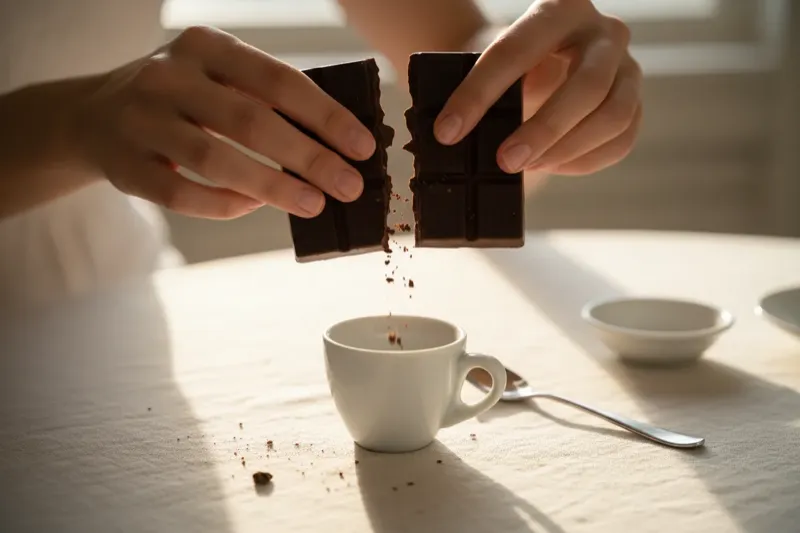
Nutritional psychology identifies four distinct types of eating — fuel, joy, fog, and storm — and the difference between a woman who struggles with food and one who doesn’t often comes down to which type dominates her day. French women experience every emotion you do. They get stressed, heartbroken, anxious, bored. But there is one type of eating that is virtually absent from French culture, and it is the very one that traps millions of American women in a cycle they cannot name.
I am Marion, and I grew up in Lyon watching my mother, my aunts, my grandmother sit down to meals that were events. Not elaborate events — Tuesday lunch was not a production. But it was intentional. The table was set. The food was tasted. The conversation flowed. When I moved to America, I was stunned to discover that most women I met ate the majority of their food while doing something else entirely.
Driving. Working. Scrolling. Standing over the kitchen counter.
And then they wondered why food never satisfied them.
The Four Types of Eating: A Framework That Changes Everything
Before I explain what French women do differently, you need to understand the four types. This framework comes from nutritional psychology research, and once you see it, you cannot unsee it.
Every single time you put food in your mouth, you are doing one of these four things. There is no fifth option. And the balance between them determines your entire relationship with food.
Type 1: Fuel Eating
Fuel eating is straightforward. You are hungry. Your body needs energy. You eat something that provides it.
This is eating an apple because your stomach is growling at 3 PM. Making eggs in the morning because you know you need to function. Having a salad at lunch because your body is asking for something fresh.
Fuel eating is neutral. It is neither good nor bad, pleasurable nor painful. It is functional. Like putting gas in a car.
The problem? American diet culture has tried to make all eating into fuel eating. Every meal optimized. Every bite justified by nutritional necessity. “I eat to fuel my body” has become a badge of honor — and it is a deeply joyless way to live.
French women fuel eat, of course. But they would never describe their relationship with food in those mechanical terms. Because fuel eating, on its own, is not enough to sustain a happy human being.
Type 2: Joy Eating
This is where French culture shines so brightly that it practically blinds you.
Joy eating is eating for the pure, conscious pleasure of it. The first bite of a perfectly ripe peach in July. A square of dark chocolate after dinner, eaten slowly, with coffee. A long Sunday lunch where the courses keep coming and the conversation never stops.
Joy eating requires two things: awareness and permission.
You must be present — tasting, smelling, noticing texture and temperature. And you must have permission — internal permission to enjoy food without guilt, without calculation, without the mental tax of wondering whether you “should” be eating this.
In France, joy eating is not a special occasion. It is Tuesday. It is the butter on your morning tartine. It is the cheese course that comes before dessert. It is the way my mother would close her eyes on the first sip of her evening wine and say “Ah, ça fait du bien” — “Ah, that does good.”
Joy eating is the antidote to almost every food problem American women face. When your meals are genuinely pleasurable, when you taste every bite, when eating is an experience rather than a transaction — the urge to eat for other reasons begins to dissolve.
I wrote more about this distinction in my piece on emotional eating versus pleasure eating, and understanding the difference changed the lives of many women who read it.
Type 3: Fog Eating
Here it is. The type French women almost never do.
Fog eating is eating without awareness. You are not hungry. You are not particularly enjoying the food. You are just… eating. Your hand moves to the bag, to the box, to the container, and you consume without registering what is happening.
Fog eating is the chips you eat while watching Netflix, and when you look down, the bag is empty, and you think — wait, did I eat all of that?
It is the handful of crackers while you cook dinner. The leftover macaroni and cheese from your kid’s plate that you eat standing up at the counter. The snack drawer at work that you visit every hour without ever making a conscious decision to do so.
Fog eating is the invisible eating. It does not register as a meal. It does not register as a pleasure. It barely registers at all. And yet, for many American women, fog eating accounts for a staggering portion of their daily food intake.
Why don’t French women fog eat? It is not willpower. It is not discipline. It is structure.
French meals are structured. You eat at the table. You eat at specific times. Snacking between meals is culturally unusual — not because it is forbidden, but because meals are satisfying enough that you simply do not need to.
When you sit down to a proper lunch at noon — a real lunch, with real food, at a real table — you do not find yourself rummaging through the pantry at 2:30. The fog never forms because you were never in a food vacuum to begin with.
This is the great insight that most diet culture detox programs miss entirely. They focus on what you eat. The French focus on how you eat. And the how eliminates the fog.
Type 4: Storm Eating
Storm eating is the dramatic one. The one most people picture when they hear “emotional eating.”
Storm eating is eating driven by intense emotion. You had a terrible fight with your partner. You got devastating news. Your anxiety is so high that your skin feels electric. And you eat — fast, urgently, almost desperately — not for fuel, not for joy, but for relief.
Storm eating is a coping mechanism, and I want to be very clear: it is not a moral failing. If food is the most available source of comfort in a moment of genuine distress, your brain will reach for it. That is not weakness. That is neuroscience.
French women storm eat too. I have seen my own mother demolish half a tarte after a particularly brutal day. The difference is what happens after.
In American diet culture, storm eating triggers a shame spiral. You ate “too much.” You “lost control.” You were “bad.” And so the next day, you restrict — which makes you hungrier — which makes the next storm worse — which deepens the shame. The cycle feeds itself.
In French culture, there is no shame spiral because there is no moral framework around food. My mother ate half the tarte. The next morning, she had her normal coffee and tartine. Nothing to make up for. Nothing to compensate. The storm passed, and life resumed.
That is the crucial difference. Not that storms never happen — but that they do not create wreckage.
Why American Women Get Trapped in Fog and Storm
If you are reading this and recognizing yourself in the fog eating and storm eating descriptions, I want you to understand something: this is not your fault.
The American food environment is specifically engineered to create fog eating. Snack foods are designed to be eaten mindlessly. Portion sizes assume you will not be paying attention. Eating at your desk, in your car, in front of screens is normalized to the point where eating without distraction feels strange.
And the diet industry — the one that claims to solve your food problems — actually makes storm eating worse. Every restriction creates pressure. Every “plan” creates rules that can be broken. Every broken rule creates shame. Every shame cycle creates a storm.
You have been set up to fail, and then blamed for failing.
French women are not morally superior. They are not more disciplined. They are operating within a cultural system that makes fog eating structurally difficult and storm eating structurally unnecessary.
As I explore in my article on eating without guilt, the absence of guilt is not a personality trait. It is an environment.
The Science Behind Why Joy Eating Protects You
Here is what the research shows, and it is fascinating.
When you eat with full sensory awareness — joy eating — your brain registers satisfaction faster and more completely. A 2013 study in the journal Appetite found that participants who ate mindfully reported significantly higher satisfaction from smaller amounts of food. Not because they were trying to eat less, but because their brains actually processed the food.
Fog eating bypasses this mechanism entirely. Your brain does not register food you eat while distracted. A study from the American Journal of Clinical Nutrition found that eating while watching television increased food intake by up to 25% — not because people were hungrier, but because the satisfaction signal never arrived.
Your body is not asking for more food. Your brain is asking for the experience of eating that it never received.
This is why the French approach works without any rules about what or how much to eat. When you sit down, slow down, and actually taste your food, your brain does the regulation for you. The satiety signals work. The pleasure centers activate. The meal ends — naturally, without force, without counting, without willpower.
Ghrelin, the hormone that drives hunger, decreases more rapidly when meals are eaten slowly and with attention. Leptin, the satiety hormone, functions more effectively when you are relaxed at the table rather than stressed at your desk. The French meal ritual is not just cultural — it is biological wisdom.
How to Shift Your Balance: Practical Steps
You cannot become French overnight, and you do not need to. But you can begin shifting away from fog eating and toward joy eating starting today.
Step 1: Name What You Are Doing
For one week, before every time you eat, silently ask yourself: “Is this fuel, joy, fog, or storm?”
Do not judge the answer. Do not try to change anything. Just notice. Awareness alone begins to dissolve fog eating, because fog eating requires unawareness to survive. The moment you name it, you have already changed it.
Step 2: Create One Joy Meal Per Day
Pick one meal — any meal — and make it a joy eating experience. Sit at a table. Put the food on a real plate. Turn off your phone. Take three breaths before you start.
Then eat as if the food deserves your attention. Because it does.
You do not need to cook an elaborate French meal. A simple sandwich eaten with full attention is more nourishing — emotionally and physiologically — than an organic superfood bowl eaten over the kitchen sink while answering emails.
Step 3: Remove Fog Eating Triggers
Fog eating needs an environment to survive. It thrives on open bags, visible snack bowls, food within arm’s reach of your workspace, and eating positions that are not the table.
This is not about removing food from your home. It is about making eating a decision rather than a default. In France, food is kept in the kitchen. You go to it. It does not come to you.
Step 4: Build a Storm Kit (That Is Not Food)
Storm eating happens because food is the most accessible comfort. So make other comforts equally accessible.
A hot bath drawn in under three minutes. A playlist that shifts your emotional state. A walk around the block. A phone call to someone who makes you laugh. The goal is not to deny yourself comfort — it is to expand your options.
French women are not stoic. They simply have a wider repertoire of pleasures. A beautiful meal, yes — but also a long walk, a good book, a conversation that lasts until midnight, a perfectly applied lipstick that makes them feel like themselves again.
Step 5: Forgive the Storms
They will still happen. And when they do, practice the French morning-after: nothing happened. No penance. No compensation. No “getting back on track” — because you were never off a track. You are a human being who had a hard moment and reached for comfort.
That is all it was.
The next meal is just the next meal.
The Deeper Truth
The reason French women have a different relationship with food is not that they have mastered some secret technique. It is that their culture never pathologized eating in the first place.
When food is allowed to be pleasurable, you do not need to eat in a fog to enjoy it. When there is no moral framework around meals, storms do not create shame spirals. When joy eating is the baseline, fuel eating takes care of itself.
You do not need to fix your relationship with food. You need to stop punishing yourself for having one.
If you are recognizing yourself in these patterns — if fog eating has been your invisible companion and storm eating your shameful secret — I want you to know that there is a way through that does not involve more rules, more restriction, or more self-discipline.
It involves more pleasure. More attention. More permission.
It involves eating like a French woman — not because French women are perfect, but because they never tried to be.
If you are ready to shift from fog eating to joy eating, I created a free guide that walks you through the French approach step by step. No meal plans, no food rules — just the principles that French women absorb from childhood, adapted for your life right now. Get your free guide here.
Want the full French approach?
Get my free guide: "The 7 Habits That Naturally Trigger GLP-1"
Frequently Asked Questions
What are the 4 types of emotional eating?
Nutritional psychology identifies four types of eating: fuel eating (eating for energy and nutrition), joy eating (eating for genuine pleasure and sensory delight), fog eating (eating without awareness, often while distracted), and storm eating (eating driven by intense emotions like stress, sadness, or anxiety). French culture naturally maximizes joy eating and virtually eliminates fog eating through its meal rituals.
What medication is used for emotional eating?
While some doctors prescribe SSRIs or appetite suppressants for severe emotional eating, medication addresses symptoms rather than root causes. The more sustainable approach is restructuring your relationship with food — making meals so pleasurable and intentional that emotional eating loses its appeal. This is what French dining culture accomplishes naturally through structured, savored meals.